1.8 Total Probability
Key Terms
- Partition(分割)
A group of non-overlapping events that together cover the whole sample space.
- Total probability(全機率)
A method for finding an overall probability by combining probabilities from all possible cases.
- Case(情況)
One possible situation or branch in a partition.
- Path probability(路徑機率)
The probability of one complete route in a probability tree.
1.8.2 Learning Outcomes
After completing this section, students should be able to:
explain what a partition is;
identify whether several events form a partition of a sample space;
explain why the total probability rule works;
use the total probability rule for several cases;
use the two-case form with \(B\) and \(B^c\);
organize a total probability problem using a tree diagram;
multiply probabilities along one path;
add different paths that lead to the same final event;
distinguish a conditional probability within one case from an overall probability;
choose the correct steps for a basic total probability problem.
1.8.3 From Splitting One Event to Several Cases
In Section 1.5, we used the idea
This works because \(B\) and \(B^c\) divide the sample space into two non-overlapping cases.
Every outcome is either in \(B\) or in \(B^c\).
Therefore, event \(A\) can occur in one of two ways:
or
The same splitting idea is shown visually below with the event labels reversed. In the figure, \(A\) and \(A^c\) form the two possible cases, while \(B\) is the event being split.
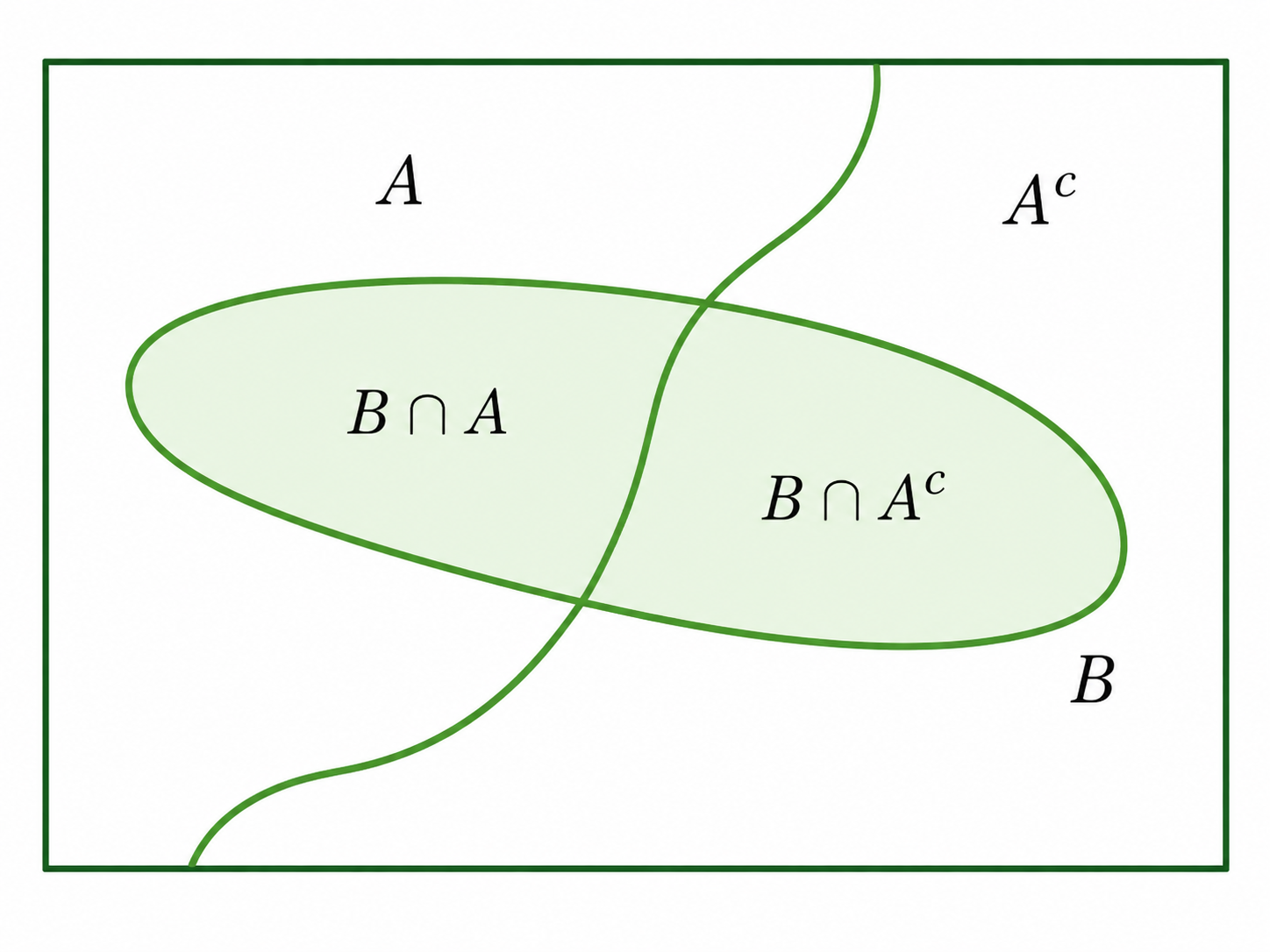
Every outcome in \(B\) must lie either inside \(A\) or inside \(A^c\). Therefore,
The two pieces do not overlap, so
The letters are different from the equation above, but the structure is the same: a complete event is divided into non-overlapping pieces according to the possible cases.
This picture gives the basic geometric idea behind total probability. The next step is to extend the same split from two cases to several cases.
The total probability idea extends this same reasoning from two cases to several cases.
Suppose the possible cases are
To use total probability, these cases must form a partition of the sample space.
1.8.4 Partition
A collection of events
forms a partition of the sample space \(S\) when two conditions hold.
First, the events do not overlap.
For different cases,
This means that two different cases cannot occur at the same time.
Second, the cases together cover the whole sample space:
This means that one of the cases must occur.
Note
Partition
A partition is a collection of cases that is
non-overlapping; and
exhaustive.
Therefore, exactly one case must occur.
Because the cases form the entire sample space,
1.8.5 Example 1: Roll One Fair Die
Suppose one fair die is rolled.
Define
and
These events do not overlap.
For example,
The same is true for every other pair.
Also,
Therefore,
form a partition of the sample space.
Each die result belongs to exactly one of the three cases.
This is the basic structure needed for the total probability rule.
1.8.6 How an Event Is Split Across a Partition
Now suppose another event \(A\) can occur under any of the cases
Because exactly one case must occur, event \(A\) can be separated into the pieces
Together,
The figure below shows this same structure for four cases. It uses \(E_1,E_2,E_3,E_4\) for the partition and \(B\) for the event of interest.
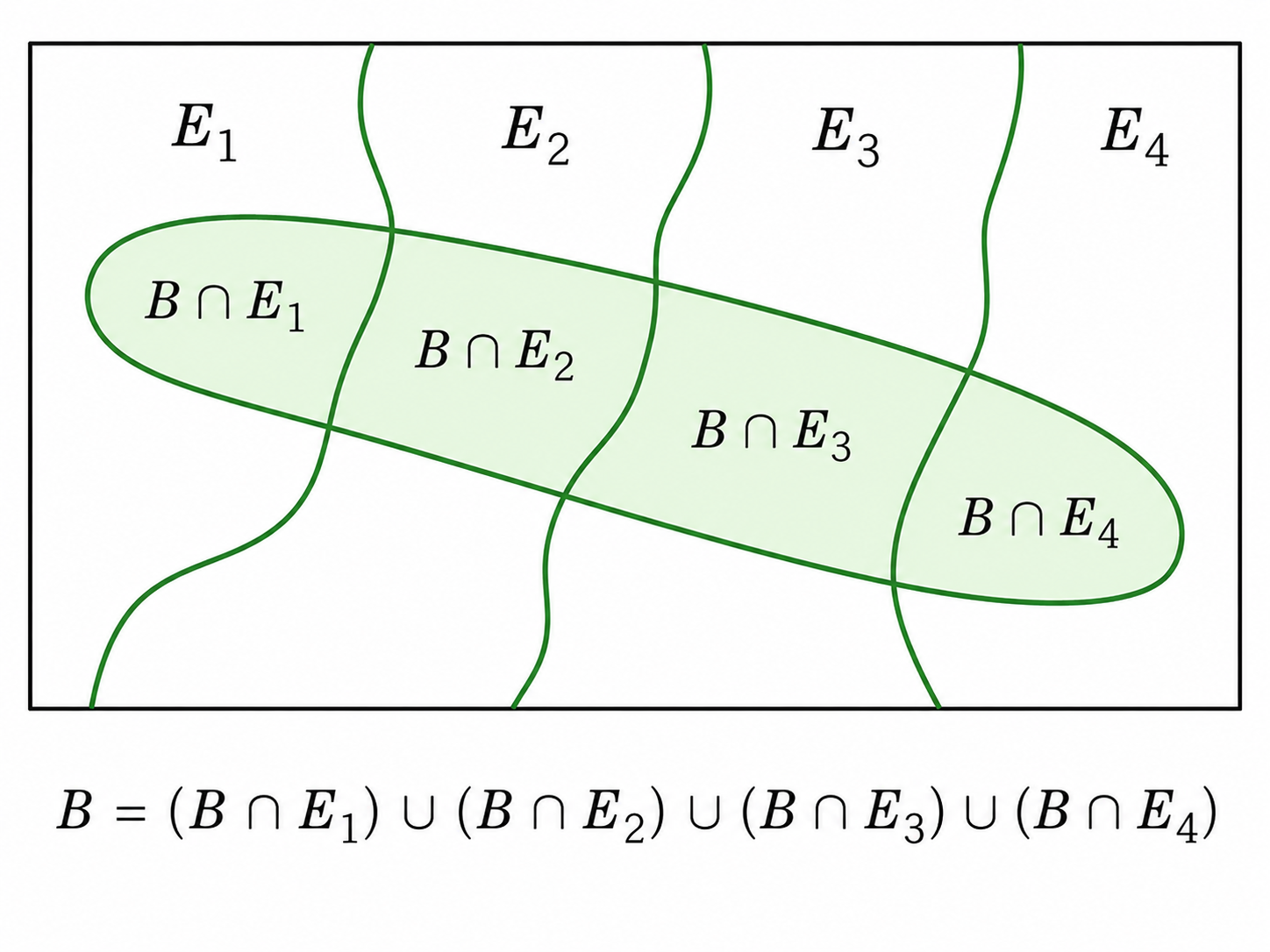
The four case regions cover the whole sample space, so every point of \(B\) must belong to exactly one of them. The event is therefore split into
and
The notation in the figure is equivalent to the notation used in this section:
Visually, no part of the event is counted twice because the partition cases do not overlap, and no part is missed because the cases cover the whole sample space.
These pieces do not overlap because the \(B_i\) events do not overlap.
Therefore, their probabilities can be added:
From the multiplication rule,
Substituting this into the previous expression gives the total probability rule.
1.8.7 Total Probability Rule
If
form a partition of the sample space, then
Note
Total Probability Rule
The structure is important.
For each case:
is the probability of following that case and then reaching event \(A\).
So the method is:
multiply within each case
then add the cases
Another useful way to write the idea is:
case probability x probability of \(A\) within that case = probability of that path to \(A\)
Then add all paths that lead to \(A\).
1.8.8 Example 2: Choose One of Two Coins
One of two coins is chosen at random.
\(C_1\) is a fair coin.
\(C_2\) is a double-headed coin.
Each coin is selected with probability
and
Let \(H\) be the event of getting heads.
For Coin 1,
For Coin 2,
There are two possible ways to get heads.
Path 1: Choose Coin 1, then get heads
Using the multiplication rule,
Therefore,
Path 2: Choose Coin 2, then get heads
Therefore,
The two paths cannot occur together because only one coin is selected.
Therefore, add the path probabilities:
Thus,
The answer \(3/4\) is the overall probability of heads.
It is not the probability of heads for Coin 1 or Coin 2 separately.
The conditional probabilities
and
describe heads within each individual case.
Total probability combines these cases into one overall probability.
1.8.9 Why the Case Probabilities Matter
A common mistake is to add the conditional probabilities directly.
For the coin example, this would give
This is not a valid total probability calculation.
The two conditional probabilities describe different cases.
Each must first be weighted by the probability that its case is selected.
The correct calculation is
Thus,
The case probabilities tell us how often each conditional situation contributes to the overall result.
1.8.10 Tree Diagram
A tree diagram makes the total probability structure visible.
For the two-coin example:
                 H: 1/2
               /
C1: 1/2 ------+
               \
                 T: 1/2


                 H: 1
               /
C2: 1/2 ------+
               \
                 T: 0
There are two paths that lead to heads.
For the first path,
multiply along the path:
For the second path,
multiply along the path:
Then add the two paths:
Note
Tree rule
Multiply probabilities along one path.
Add different paths that lead to the same final event.
The first operation is the multiplication rule.
The second operation is the addition rule for mutually exclusive paths.
1.8.11 Reading a Total Probability Tree
A total probability tree usually has two stages.
Stage 1: Choose the case
The first branches represent
Their probabilities must add to 1:
Stage 2: Event within each case
From each case, the next branches show conditional probabilities such as
and
For each case,
Path probability
A path such as
has probability
Overall probability
If several paths end at \(A\), add them:
This gives the same total probability rule in visual form.
1.8.12 Example 3: Choose One of Two Card Piles
One of two card piles is selected.
Pile \(B_1\) is selected with probability
and contains:
3 red cards;
1 black card.
Pile \(B_2\) is selected with probability
and contains:
1 red card;
3 black cards.
One card is drawn from the selected pile.
Let \(R\) be the event that the card is red.
For the first pile,
For the second pile,
Now calculate the path through \(B_1\):
The path through \(B_2\) is
Add the two ways to obtain a red card:
Notice that the two piles are not selected with equal probability.
This is why the values \(1/3\) and \(2/3\) must be included in the calculation.
The conditional probability of red is higher in Pile 1, but Pile 2 is more likely to be selected.
Total probability combines both pieces of information.
1.8.13 Two-Case Form
A common partition contains only two cases:
and
These two events are automatically non-overlapping:
They also cover the whole sample space:
Therefore, they form a partition.
The total probability rule becomes
Note
Two-Case Total Probability Rule
This form is useful whenever a problem naturally separates into
case \(B\)
and
case not \(B\).
1.8.14 Why the Two-Case Form Matches Earlier Probability Rules
The two-case form is not a completely new idea.
Recall from Section 1.5 that
The two parts are mutually exclusive, so
Using the multiplication rule,
and
Therefore,
So total probability combines ideas already studied:
splitting an event;
mutually exclusive addition;
conditional probability;
multiplication along a path.
1.8.15 A Simple Method
For a total probability problem, use the following steps.
Step 1: Identify the possible cases.
Write
Ask:
What different cases can happen first?
Step 2: Check that the cases form a partition.
The cases must:
not overlap; and
cover all possible outcomes.
Step 3: Write the probability of each case.
Find
Check that they add to 1.
Step 4: Find the probability of the final event within each case.
Find
Step 5: Multiply within each case.
Calculate
This is the probability of the path
Step 6: Add all paths leading to the event.
Use
A useful summary is:
identify the cases
-> multiply along each path
-> add the paths to the same event
1.8.16 Common Mistakes
A common mistake is to use total probability when the cases do not form a partition.
The cases must be non-overlapping and together cover the whole sample space.
Another mistake is to add conditional probabilities directly.
For example,
is not generally equal to \(P(A)\).
Each conditional probability must be weighted by its case probability:
A third mistake is to forget one possible path to the final event.
If event \(A\) can occur through several cases, every path to \(A\) must be included.
A fourth mistake is to add branch probabilities along one path.
Along one path, multiply.
Across different mutually exclusive paths that lead to the same event, add.
Another mistake is to forget that the second-stage probabilities are conditional probabilities.
For a branch beginning with \(B_i\), the next probability is
not simply \(P(A)\).
A final mistake is to assume that all cases are equally likely.
In the card-pile example,
and
The different case probabilities must be used.
1.8.17 Summary
A partition divides the sample space into cases that are
mutually exclusive; and
exhaustive.
For a partition
exactly one case must occur.
The total probability rule is
For each case,
is the probability of the path
The main tree rule is:
multiply along a path
add paths leading to the same event
For two complementary cases,
The main idea is:
several possible cases -> one final event
combine all paths -> overall probability
Before calculating:
identify the possible cases;
check that they form a partition;
write the probability of each case;
write the conditional probability of the final event in each case;
multiply within each path;
add all paths leading to the event.