1.1 Sample Space
Key Terms
- Experiment(隨機試驗)
A process that gives an uncertain result.
- Outcome(結果)
One possible result of an experiment.
- Sample point(樣本點)
One individual outcome in a sample space.
- Sample space(樣本空間)
The set of all possible outcomes. We usually use the symbol \(S\).
1.1.2 Learning Outcomes
After completing this section, students should be able to:
explain experiment, outcome, sample point, and sample space in simple words;
write the sample space for a simple experiment;
explain why the same experiment can have different sample spaces;
use a tree diagram to list outcomes systematically;
describe a large or infinite sample space using a rule.
1.1.3 Sample Space
Probability starts with a simple question:
What can happen?
An experiment is a process with an uncertain result.
One possible result is called an outcome.
The sample space is the set of all possible outcomes of the experiment.
Note
Sample space :math:`S`: the set of all possible outcomes.
The main connection is:
Experiment -> Outcome -> Sample Space
Each individual outcome in the sample space is called a sample point.
For example, if
then \(4\) is one sample point, and we can write
1.1.4 Example 1: Rolling One Die
Experiment: Roll one six-sided die one time.
The possible outcomes are
Therefore, the sample space is
There are six sample points in this sample space.
The important idea is that the sample space must include all possible outcomes.
1.1.5 Same Experiment, Different Sample Space
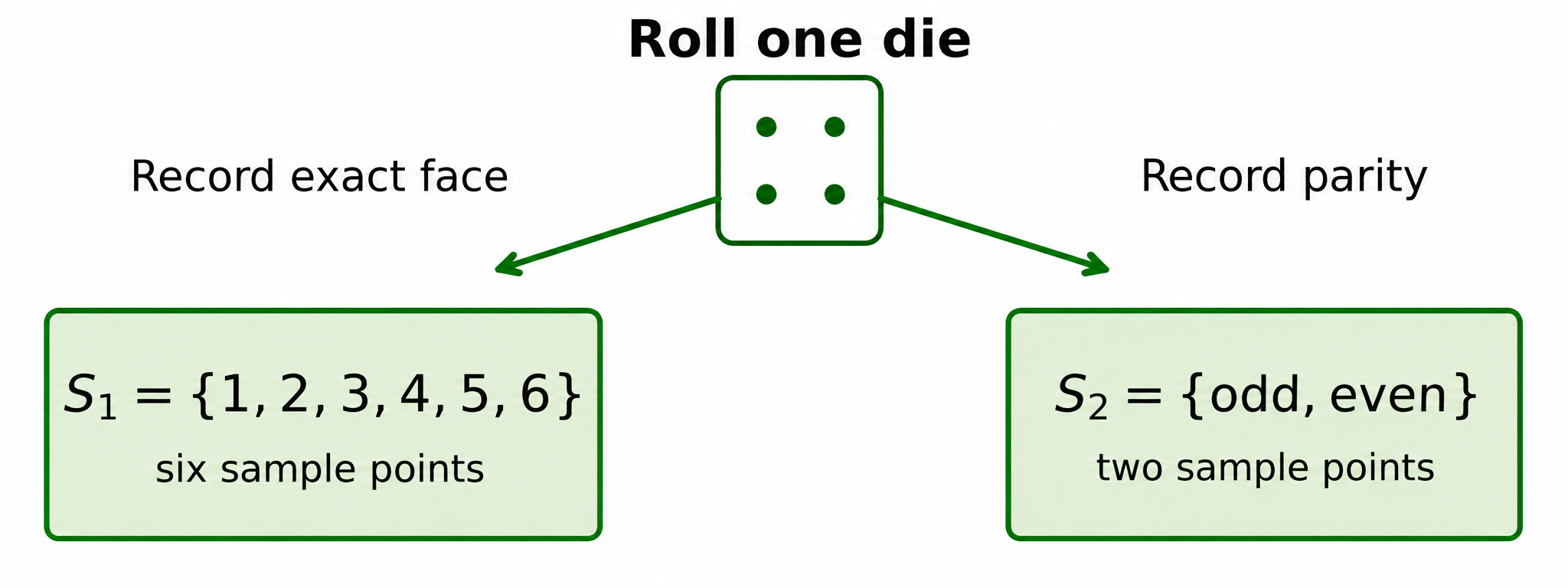
Suppose we roll one die.
If we record the exact number on the top face, the sample space is
Now suppose we roll the same die, but we record only whether the result is odd or even.
Then the sample space is
The experiment is the same, but the information we record is different.
The sample space therefore depends on the result that we choose to record. The same physical experiment can lead to different, equally valid sample spaces.
Note
The sample space depends on what we record.
The first sample space gives more information than the second one.
For example, if we know that the die shows 4, we also know that the result is even. However, if we only know that the result is even, we do not know whether the die shows 2, 4, or 6.
1.1.6 Ways to Describe a Sample Space
For a small sample space, we can list all possible outcomes.
For a process with several steps, a tree diagram can help us list the outcomes in a systematic way.
For a large or infinite sample space, it is often better to describe the possible values using a rule.
1.1.7 Example 2: Tossing a Coin Twice
Experiment: Toss one coin two times.
A tree diagram helps us list all possible outcomes. At each toss, the process branches according to whether the result is heads or tails. Following a path from the starting point to an endpoint gives one complete sample point.
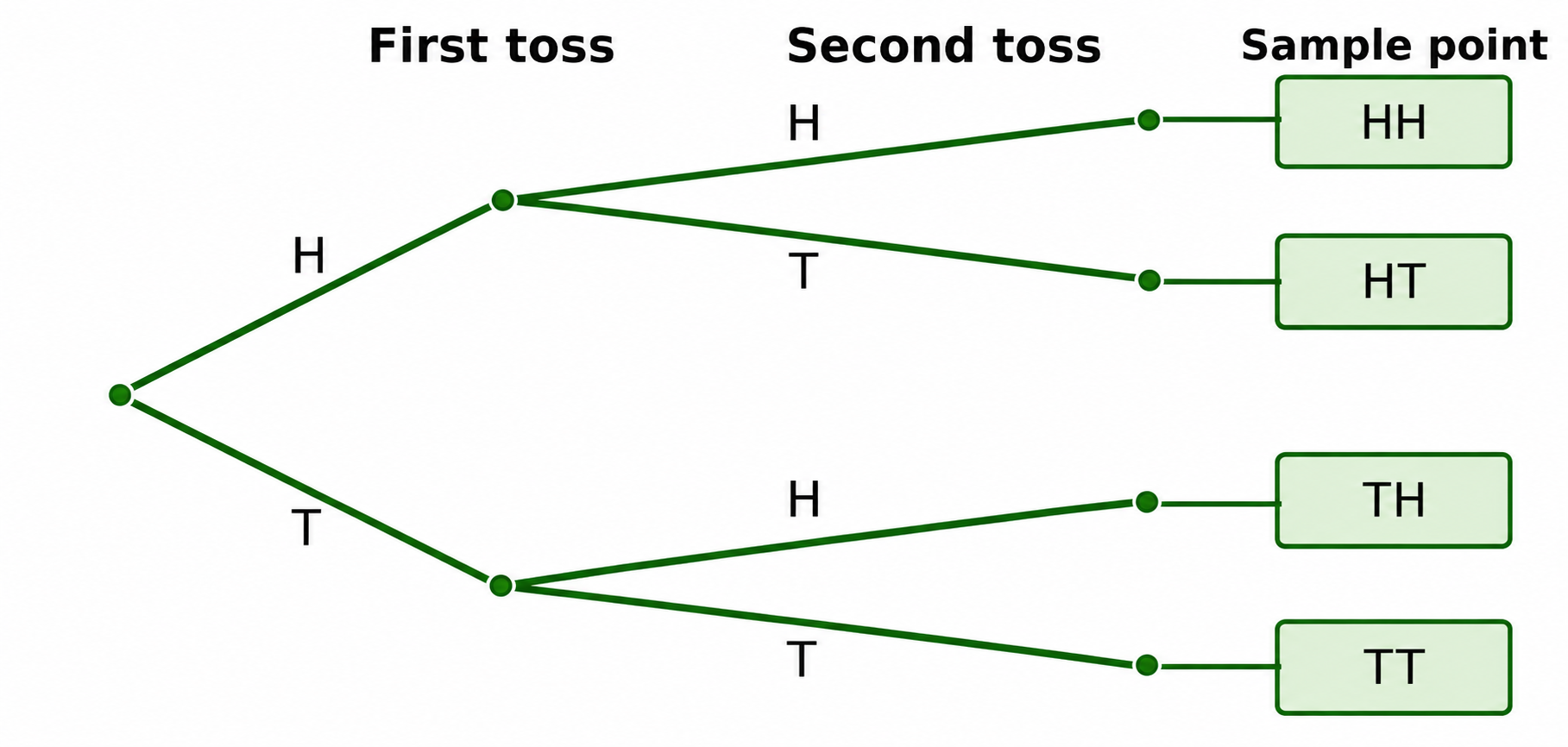
Therefore,
For example, HT means heads on the first toss and tails on the second toss.
Note
A tree diagram is a systematic way to list possible outcomes.
It helps us check that no possible outcome is missing.
1.1.8 Example 3: A Large or Infinite Sample Space
Suppose \(X\) represents the lifetime of an object.
A lifetime cannot be negative. The possible values are all nonnegative values.
Because there are infinitely many possible values, we do not list them one by one. Instead, we write
Here, the symbol \(\mid\) means such that.
So the expression means:
\(S\) is the set of all values \(x\) such that \(x\) is greater than or equal to 0.
This gives two common ways to describe a sample space:
Type |
Method |
Example |
|---|---|---|
Finite and simple |
List the outcomes |
\(S=\{1,2,3,4,5,6\}\) |
Large or infinite |
Describe the possible values |
\(S=\{x\mid x\geq0\}\) |
1.1.9 A Simple Method
When you need to describe a sample space, ask these questions:
What is the experiment?
What result are we recording?
What are all possible outcomes?
Is the sample space small enough to list?
If the process has several steps, would a tree diagram help?
If the sample space is large or infinite, can we describe it using a rule?
The goal is always the same:
Describe all possible outcomes clearly.
1.1.10 Common Mistakes
A common mistake is to leave out a possible outcome.
For two coin tosses,
is complete. Writing only \(\{HH,HT,TT\}\) is not correct because TH is
missing.
Another mistake is to forget what is being recorded.
For one die roll,
and
can both be correct sample spaces. They answer different questions about the same experiment.
A third mistake is to try to list every value in a large or infinite sample space. In this case, a rule is usually clearer.
1.1.11 Summary
An experiment is a process with an uncertain result.
An outcome is one possible result.
A sample point is one individual outcome in the sample space.
A sample space contains all possible outcomes.
The main connection is:
Experiment -> Outcome -> Sample Space
For a small sample space, we can list the outcomes.
For a process with several steps, a tree diagram can help us list the outcomes systematically.
For a large or infinite sample space, we can describe the possible values using a rule.
Note
Main idea: A sample space must describe all possible outcomes.