1.2 Events
Key Terms
- Event(事件)
A set of outcomes from the sample space.
- Complement(餘事件)
All outcomes in the sample space that are not in an event.
- Intersection(交集)
The outcomes that are in both events.
- Union(聯集)
The outcomes that are in one event, the other event, or both.
- Mutually exclusive(互斥事件)
Two events that cannot happen together.
- Empty set(空集合)
A set with no outcomes. We use the symbol \(\varnothing\).
1.2.2 Learning Outcomes
After completing this section, students should be able to:
explain an event in simple words;
identify an event as a subset of a sample space;
use \(A^c\), \(A \cap B\), and \(A \cup B\);
explain the meanings of
NOT,AND, andOR;use a Venn diagram to describe events;
identify mutually exclusive events;
explain the impossible event and the certain event.
1.2.3 Event
In the previous section, we asked:
What can happen?
The answer was the sample space.
Now we ask:
Which outcomes do we care about?
The answer is an event.
An event is a set of outcomes from the sample space.
Note
Event: a set of outcomes from the sample space.
If the sample space is \(S\) and an event is \(A\), we write
This means that every outcome in \(A\) must also be in \(S\).
1.2.4 Example 1: Roll One Die
Experiment: Roll one six-sided die one time.
The sample space is
Define event \(A\) as rolling an even number:
Define event \(B\) as rolling a number greater than 3:
Both events are subsets of the sample space:
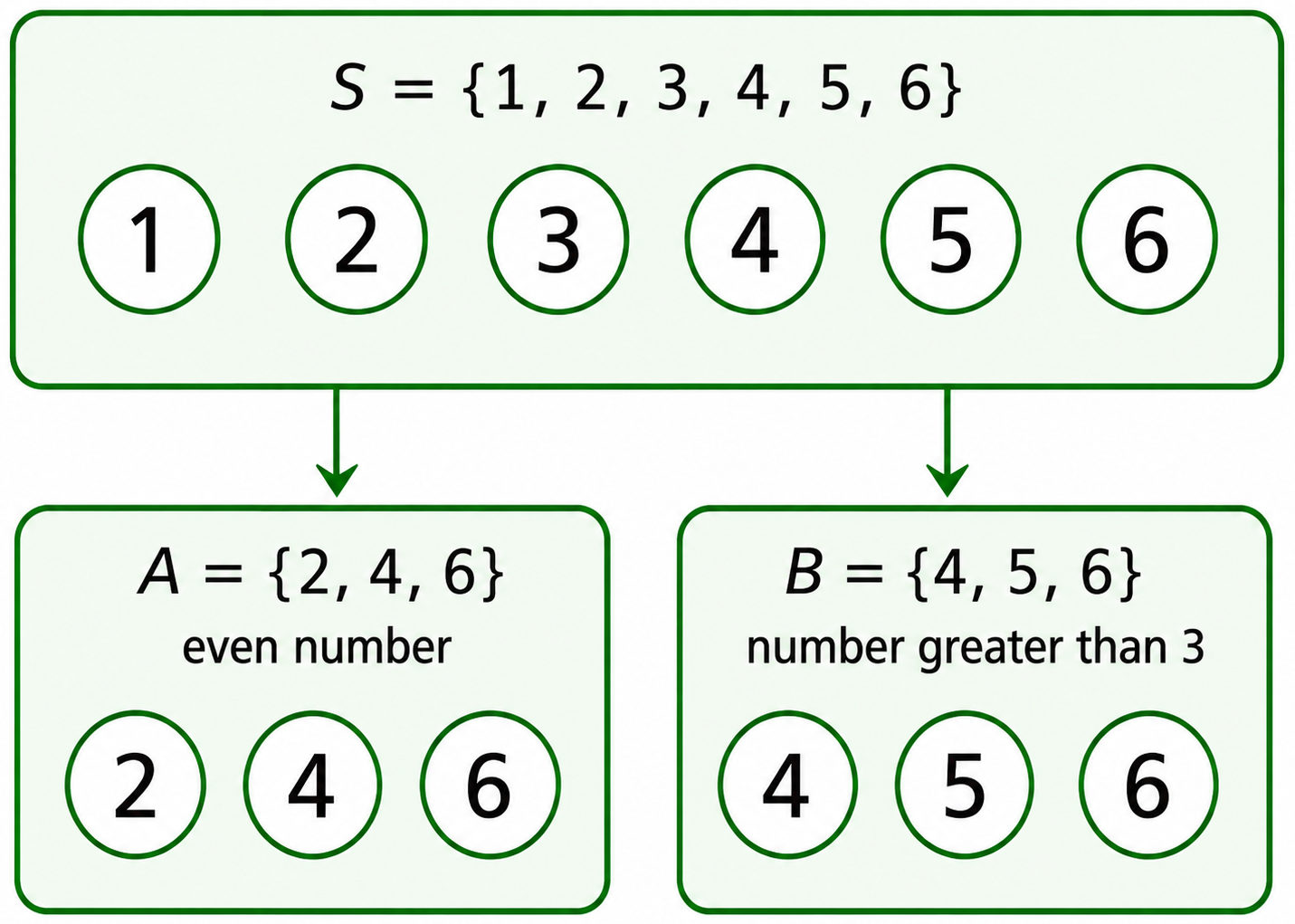
This figure shows that events \(A\) and \(B\) are subsets chosen from the sample space \(S\).
We will use these two events to study the main event notation.
1.2.5 Event Notation
Three important ideas are NOT, AND, and OR.
Meaning |
Symbol |
Simple description |
|---|---|---|
NOT \(A\) |
\(A^c\) |
Outcomes not in \(A\) |
\(A\) AND \(B\) |
\(A \cap B\) |
Outcomes in both \(A\) and \(B\) |
\(A\) OR \(B\) |
\(A \cup B\) |
Outcomes in \(A\), \(B\), or both |
1.2.6 Complement: NOT
The complement of event \(A\) contains all outcomes in \(S\) that are not in \(A\).
We write the complement as
Using
and
we get
Event \(A\) means even.
Event \(A^c\) means not even, so it means odd.
1.2.7 Intersection: AND
The intersection of \(A\) and \(B\) contains the outcomes that are in both events.
We write
Using
and
the common outcomes are 4 and 6.
Therefore,
This means:
the result is even and greater than 3.
1.2.8 Union: OR
The union of \(A\) and \(B\) contains the outcomes that are in \(A\), in \(B\), or in both events.
We write
Using the same events,
This means:
the result is even or greater than 3, or both.
Note
In probability, A or B includes the case where both \(A\) and
\(B\) happen.
For example, 4 and 6 are in both events. In a set, each outcome is written only once.
1.2.9 Venn Diagram
A Venn diagram gives a picture of events inside a sample space.
In a Venn diagram:
the rectangle represents the sample space \(S\);
a circle represents an event;
the overlap of \(A\) and \(B\) represents \(A \cap B\);
the parts inside \(A\), \(B\), or both represent \(A \cup B\);
the part outside \(A\) represents \(A^c\).
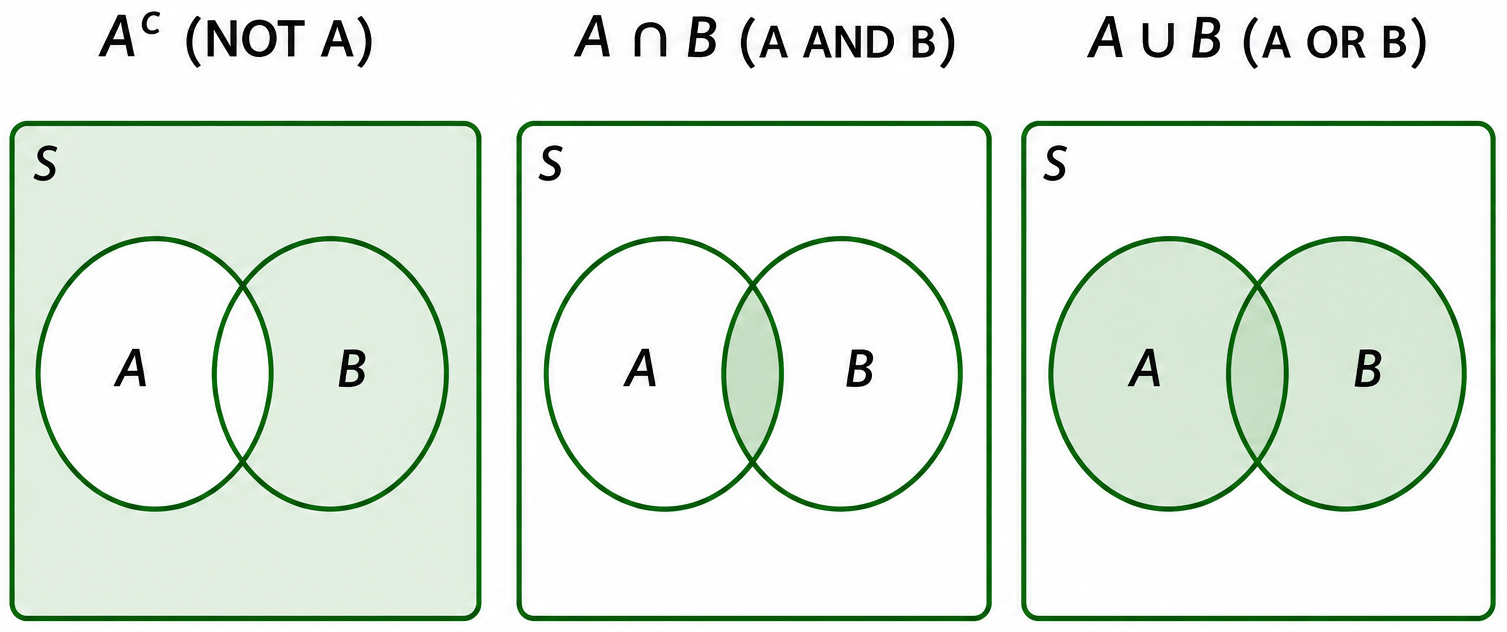
This figure shows the three main event operations visually: \(A^c\), \(A \cap B\), and \(A \cup B\).
For the die example:
Region |
Outcomes |
Meaning |
|---|---|---|
\(A\) only |
\(\{2\}\) |
Even, but not greater than 3 |
\(A \cap B\) |
\(\{4,6\}\) |
Even and greater than 3 |
\(B\) only |
\(\{5\}\) |
Greater than 3, but not even |
Outside \(A\) |
\(\{1,3,5\}\) |
NOT \(A\) |
1.2.10 Mutually Exclusive Events
Two events are mutually exclusive when they cannot happen together.
This means that they have no common outcomes.
Note
Two events are mutually exclusive if
1.2.11 Example 2: Odd vs. Even
For one die roll, define
where \(C\) is the event of rolling an odd number.
Define
where \(D\) is the event of rolling an even number.
There is no outcome that is both odd and even.
Therefore,
So, \(C\) and \(D\) are mutually exclusive.
Compare this with the earlier events \(A\) and \(B\):
Therefore, \(A\) and \(B\) are not mutually exclusive.
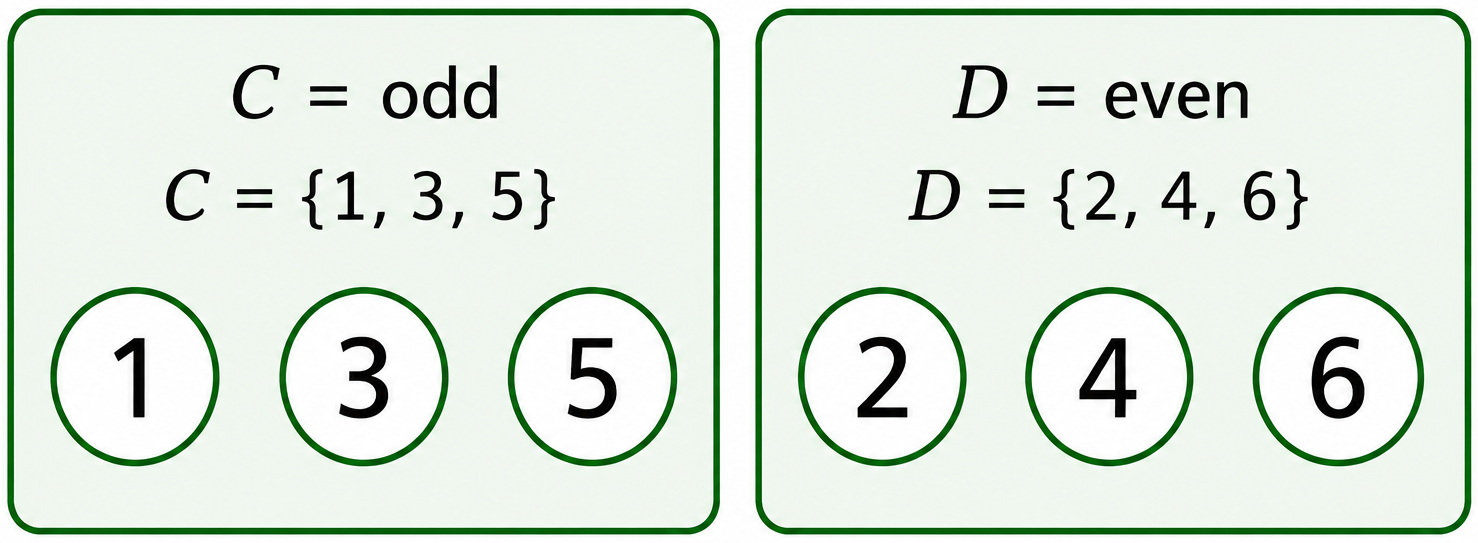
This figure shows a mutually exclusive pair of events for one die roll: odd and even.
1.2.12 Special Events
Two special events are useful.
The impossible event contains no outcomes. It is written as
For example, rolling 7 on a standard six-sided die is impossible.
The certain event is the whole sample space:
For example, when a standard die is rolled, the result must be one of
An event and its complement have two important relationships:
and
The first result means that an event and its complement cannot happen together.
The second result means that one of them must happen.
1.2.13 A Simple Method
When working with events, use these steps:
Write the sample space \(S\).
Define the event or events.
Look for the words
NOT,AND, orOR.Choose the correct symbol.
List the outcomes that match the event.
Check whether the events have common outcomes when studying mutually exclusive events.
Use this guide:
Word |
Symbol |
Meaning |
|---|---|---|
NOT |
\(A^c\) |
Outcomes not in \(A\) |
AND |
\(A \cap B\) |
Outcomes in both events |
OR |
\(A \cup B\) |
Outcomes in either event or both |
1.2.14 Common Mistakes
A common mistake is to include an outcome that is not in the sample space.
For a standard die,
Another mistake is to confuse intersection and union.
Intersection means
AND.Union means
OR.
A third mistake is to think that OR means only one event can happen.
In probability, A or B also includes the case where both events happen.
A final mistake is to call two events mutually exclusive when they have a common outcome.
If
then \(A\) and \(B\) are not mutually exclusive.
1.2.15 Summary
An event is a set of outcomes from the sample space.
The complement means NOT.
The intersection means AND.
The union means OR.
Mutually exclusive events cannot happen together.
The impossible event is \(\varnothing\).
The certain event is \(S\).
An event and its complement satisfy
and
The main idea is:
Sample Space -> Choose Events -> Use NOT, AND, or OR