1.6 Conditional Probability and Multiplication
Key Terms
- Conditional probability(條件機率)
The probability of an event when we already know that another event has occurred.
- Given(已知)
A word that tells us some information is already known.
- Condition(條件)
The event written after the vertical bar in a conditional probability.
- Reduced sample space(縮減樣本空間)
The smaller set of outcomes that remains possible after a condition is known.
- Joint probability(聯合機率)
The probability that two events occur together, such as \(P(A\cap B)\).
- Multiplication rule(乘法法則)
A rule that connects an intersection with conditional probability.
- Sequential events(序列事件)
Events that occur in stages or in a particular order.
- Tree diagram(樹狀圖)
A diagram that shows stages, possible outcomes, and their probabilities.
1.6.2 Learning Outcomes
After completing this section, students should be able to:
explain conditional probability in simple words;
interpret \(P(B\mid A)\);
identify the condition in a conditional probability;
explain how a condition changes the sample space;
calculate conditional probability from outcomes, probabilities, and a simple table;
explain why \(P(B\mid A)\) and \(P(A\mid B)\) are generally different;
use the multiplication rule for two events;
use conditional probability in sequential problems;
update probabilities when sampling without replacement;
use a tree diagram for sequential events;
extend the multiplication rule to three events;
use a complement while keeping the same condition.
1.6.3 Conditional Probability
Sometimes we know extra information before calculating a probability.
When new information is known, some outcomes may no longer be possible.
This changes the set of outcomes that we should consider.
This idea is called conditional probability.
For example,
is read as:
the probability of \(B\), given \(A\).
The vertical bar \(\mid\) is read as given.
The event after the bar is the information that is already known.
So, in
event \(A\) is the condition.
A useful way to think is:
Given \(A\) -> restrict the sample space to \(A\)
Then ask:
Among the outcomes in \(A\), how many also belong to \(B\)?
1.6.4 Example 1: Roll One Fair Die
Question: One fair die is rolled.
Let \(A\) be the event that the number is greater than 3, and let \(B\) be the event that the number is even.
Given that \(A\) occurred, find
The original sample space is
The condition is
Once we know that \(A\) occurred, outcomes 1, 2, and 3 are no longer possible.
The reduced sample space is therefore
Among these three outcomes, 4 and 6 are even.
Thus,
There are 2 favorable outcomes among the 3 outcomes that remain possible.
Therefore,
Notice that the denominator is now 3, not 6.
The condition changed the relevant sample space.
1.6.5 Conditional Probability Formula
The conditional probability of \(B\) given \(A\) is
Note
Conditional Probability
The condition \(A\) becomes the new reference space.
The denominator is \(P(A)\) because we already know that the outcome is inside \(A\).
The numerator is \(P(A\cap B)\) because we need the outcomes that are inside both \(A\) and \(B\).
For equally likely outcomes, we can also use counts:
The important idea is:
condition after the bar -> new denominator
1.6.6 Example 2: Flight
Let
\(D\) be the event that a flight departs on time;
\(A\) be the event that the flight arrives on time.
Suppose
and
Assume that departure status and arrival status are independent.
Therefore,
The remaining joint probabilities are
and
The four regions can be represented using 100 equally sized cells.
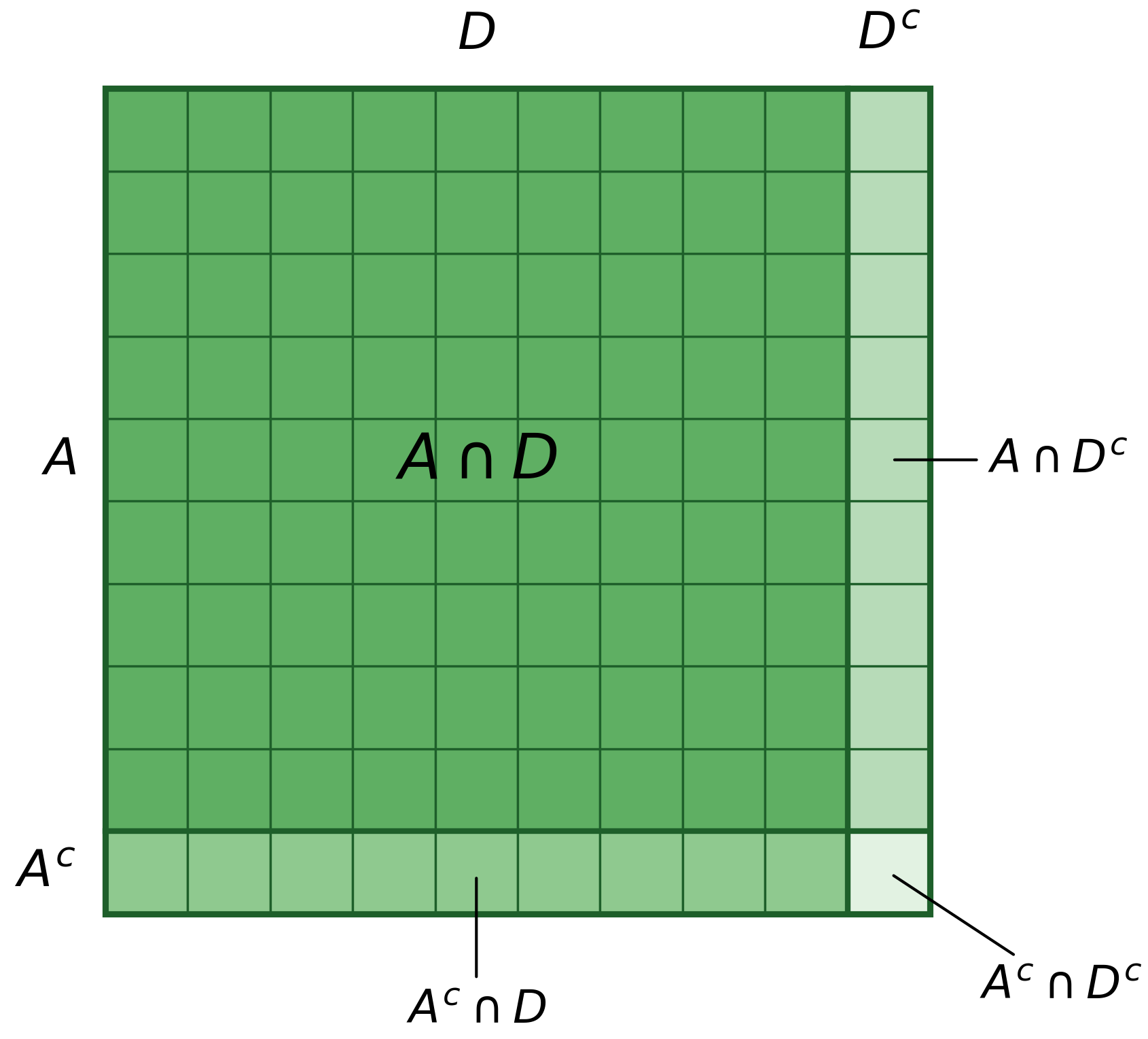
Each cell represents 1% of the flights.
The diagram contains:
81 cells in \(A\cap D\);
9 cells in \(A\cap D^c\);
9 cells in \(A^c\cap D\);
1 cell in \(A^c\cap D^c\).
The figure is especially useful for conditional probability because the condition determines which part of the diagram becomes the new reference group.
We will answer three conditional probability questions.
(a) Arrives on time, given that it departed on time
We want
The condition is \(D\).
Therefore, we consider only flights that departed on time.
In the diagram, event \(D\) contains
of the 100 cells.
Among these 90 flights, 81 also belong to \(A\).
Therefore,
Equivalently, using the cells in the figure,
Thus, among flights that depart on time, 90% arrive on time.
(b) Departed on time, given that it arrived on time
Now we want
The condition has changed from \(D\) to \(A\).
Therefore, we now consider only flights that arrived on time.
In the diagram, event \(A\) contains
cells.
Among these 90 flights, 81 also belong to \(D\).
Therefore,
Equivalently,
The intersection \(A\cap D\) is unchanged, but the group used as the denominator is now \(A\) rather than \(D\).
In this particular example, both denominators contain 90 cells, so the two conditional probabilities happen to have the same value.
(c) Arrives on time, given that it departed late
Now we want
The condition is \(D^c\).
Only
of the 100 cells belong to \(D^c\).
Of these 10 cells, 9 belong to \(A\cap D^c\).
Therefore,
Equivalently,
Thus, among flights that depart late, 90% still arrive on time.
The important idea is that conditional probability changes the reference group.
For example,
uses only the 90 cells in \(D\), whereas
uses only the 10 cells in \(D^c\).
The numerator is the part of that reference group that also belongs to the event of interest.
In this example,
This occurs because departure status and arrival status are independent. Knowing whether the flight departed on time does not change the probability that it arrives on time.
1.6.7 The Condition Determines the Denominator
In a conditional probability,
the event after the bar is what we already know.
Therefore, \(A\) becomes the new reference space.
In general,
These two probabilities ask different questions because they use different conditions.
A useful reading method is:
Read the event after the bar first.
Restrict attention to that event.
Among those outcomes, look for the event before the bar.
1.6.8 Example 3: Draw One Card
One card is drawn from a standard 52-card deck.
Let
\(R\) be the event that the card is red;
\(K\) be the event that the card is a king.
There are:
26 red cards;
4 kings;
2 red kings.
The information can be organized in a table.
King |
Not King |
Total |
|
|---|---|---|---|
Red |
2 |
24 |
26 |
Black |
2 |
24 |
26 |
Total |
4 |
48 |
52 |
(a) Both red and king
This is an intersection:
The denominator is 52 because no condition has been given.
(b) Red, given king
Now we know that the card is a king.
Only the 4 kings remain relevant.
Among the 4 kings, 2 are red.
Therefore,
(c) King, given red
Now we know that the card is red.
Only the 26 red cards remain relevant.
Among these 26 cards, 2 are kings.
Therefore,
The same intersection \(R\cap K\) is used in both conditional probabilities, but the denominators are different:
and
Note
The event after the bar determines the denominator.
This is especially useful when working with a table.
The condition tells us which row, column, or subgroup becomes the new total.
1.6.9 Multiplication Rule
The multiplication rule comes directly from the conditional probability formula.
Start with
Multiply both sides by \(P(A)\):
Note
Multiplication Rule
Equivalently,
Both forms calculate the probability that \(A\) and \(B\) occur together.
Which form should we use?
Use the form that matches the information given in the problem.
A useful language connection is:
AND -> intersection -> multiplication rule
However, the general multiplication rule does not mean that we should automatically calculate \(P(A)P(B)\).
The second probability is generally conditional:
1.6.10 Example 4: Advanced Statistics Class
A class has:
10 juniors;
30 seniors;
10 graduate students.
Among them:
3 juniors received an A;
10 seniors received an A;
5 graduate students received an A.
There are
students in total.
The number of students who received an A is
Let
\(A\) = received an A;
\(S\) = senior;
\(J\) = junior;
\(G\) = graduate student.
Therefore,
(a) Senior, given that the student received an A
We know
and
Using the multiplication rule,
Now use conditional probability:
(b) Junior, given that the student received an A
We have
and
Therefore,
Then
(c) Graduate student, given that the student received an A
We have
and
Therefore,
Then
As a check,
This makes sense because every student who received an A is either a senior, junior, or graduate student.
There is also a shorter way to see these conditional probabilities.
Once we know that the selected student received an A, the new group contains 18 students:
10 seniors;
3 juniors;
5 graduate students.
Therefore,
This gives the same results and confirms the meaning of the reduced sample space.
1.6.11 Sequential Events
Some probability experiments happen in stages.
For example,
draw a first card -> then draw a second card
The probability at a later stage may depend on what happened earlier.
This is especially important when sampling without replacement. Without replacement means that a selected object is not returned before the next selection.
After the first draw:
the total number of available objects decreases;
the number of target objects may also change.
Therefore, the probability for the second draw must be updated using the information from the first draw.
Conditional probability expresses this idea naturally. If \(A_1\) describes the first-stage event and \(A_2\) describes the second-stage event, then
means the probability that the second-stage event occurs given that the first-stage event has already occurred.
For sequential events, the important question is therefore:
What information is already known when this stage is reached?
1.6.12 Example 5: Two Aces Without Replacement
Two cards are drawn sequentially from a standard 52-card deck without replacement.
Let
\(A_1\) be the event that the first card is an ace;
\(A_2\) be the event that the second card is an ace.
For the first draw,
Now suppose the first card is known to be an ace.
Because that card is not replaced:
52 cards become 51 cards;
4 aces become 3 aces.
Therefore,
The denominator changes because the second probability is calculated under a new condition: one card has already been removed.
This answers the conditional question:
What is the probability that the second card is an ace, given that the first card was an ace?
Now consider the probability that both cards are aces.
The event that both stages succeed is
Using the multiplication rule,
Therefore,
The changing denominator is not a new probability rule. It reflects the fact that the first draw changes the situation for the second draw.
1.6.13 Tree Diagrams for Sequential Events
A tree diagram makes the stage-by-stage structure visible.
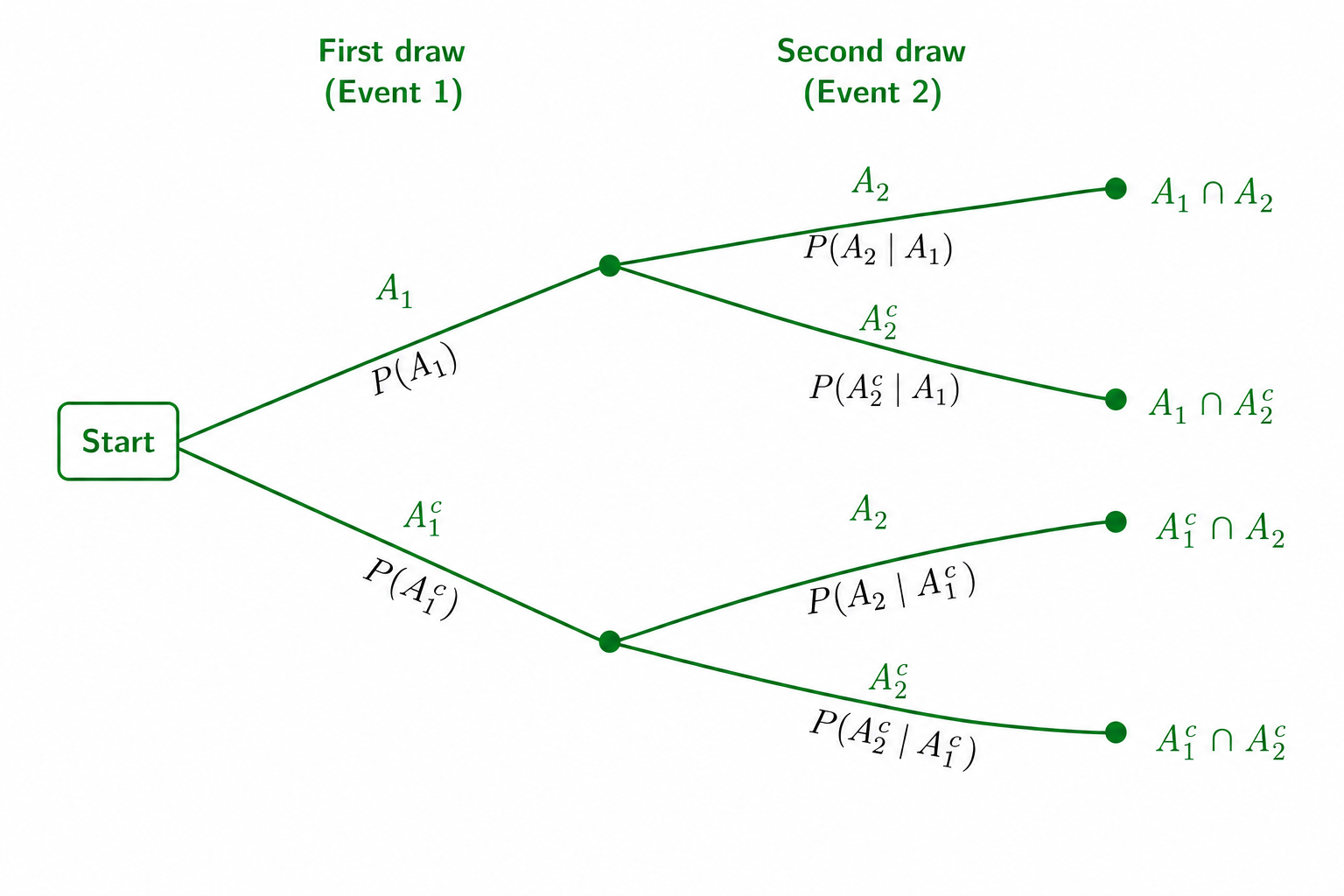
The first split represents the outcome of the first draw:
The second split depends on which first-stage branch has already occurred.
If the first card is an ace, the second-stage branches are described by
If the first card is not an ace, the conditions are different:
Thus, the second-stage probabilities are conditional probabilities because the earlier branch determines the situation at the second draw.
Each complete path through the tree represents an intersection of events. For example, the upper path represents
Its probability is obtained by multiplying the branch probabilities along that path:
For the two-ace path,
The other complete paths are interpreted in the same way:
Note
Sequential Events
At each stage, update the condition using the information already known.
For one complete path in a tree diagram, multiply the branch probabilities along that path.
The tree therefore shows two ideas at the same time:
conditioning: later branch probabilities depend on earlier outcomes;
multiplication: the probability of a complete path is the product of its branch probabilities.
1.6.14 More Than Two Events
The multiplication rule can be extended to more than two sequential events.
For three events,
Notice how the known information increases at each stage.
The first factor is the probability of \(A\).
The second factor is the probability of \(B\) given that \(A\) has already occurred.
The third factor is the probability of \(C\) given that \(A\) and \(B\) have already occurred.
So, at each step, the condition is updated to include the outcomes that are already known.
Note
Three Sequential Events
The conditioning information grows from one stage to the next.
The same idea continues for more stages. For example, with four events,
1.6.15 Example 6: First Three Cards Are Aces
Three cards are drawn sequentially from a standard 52-card deck without replacement.
Find the probability that all three cards are aces.
Let
\(A_1\) be the event that the first card is an ace;
\(A_2\) be the event that the second card is an ace;
\(A_3\) be the event that the third card is an ace.
Then we want
Using the multiplication rule for three sequential events,
For the first draw,
If the first card is an ace, then 3 aces remain among 51 cards, so
If the first two cards are aces, then 2 aces remain among 50 cards, so
Therefore,
This may also be written as
The tree diagram below helps visualize why the denominators change at each stage.
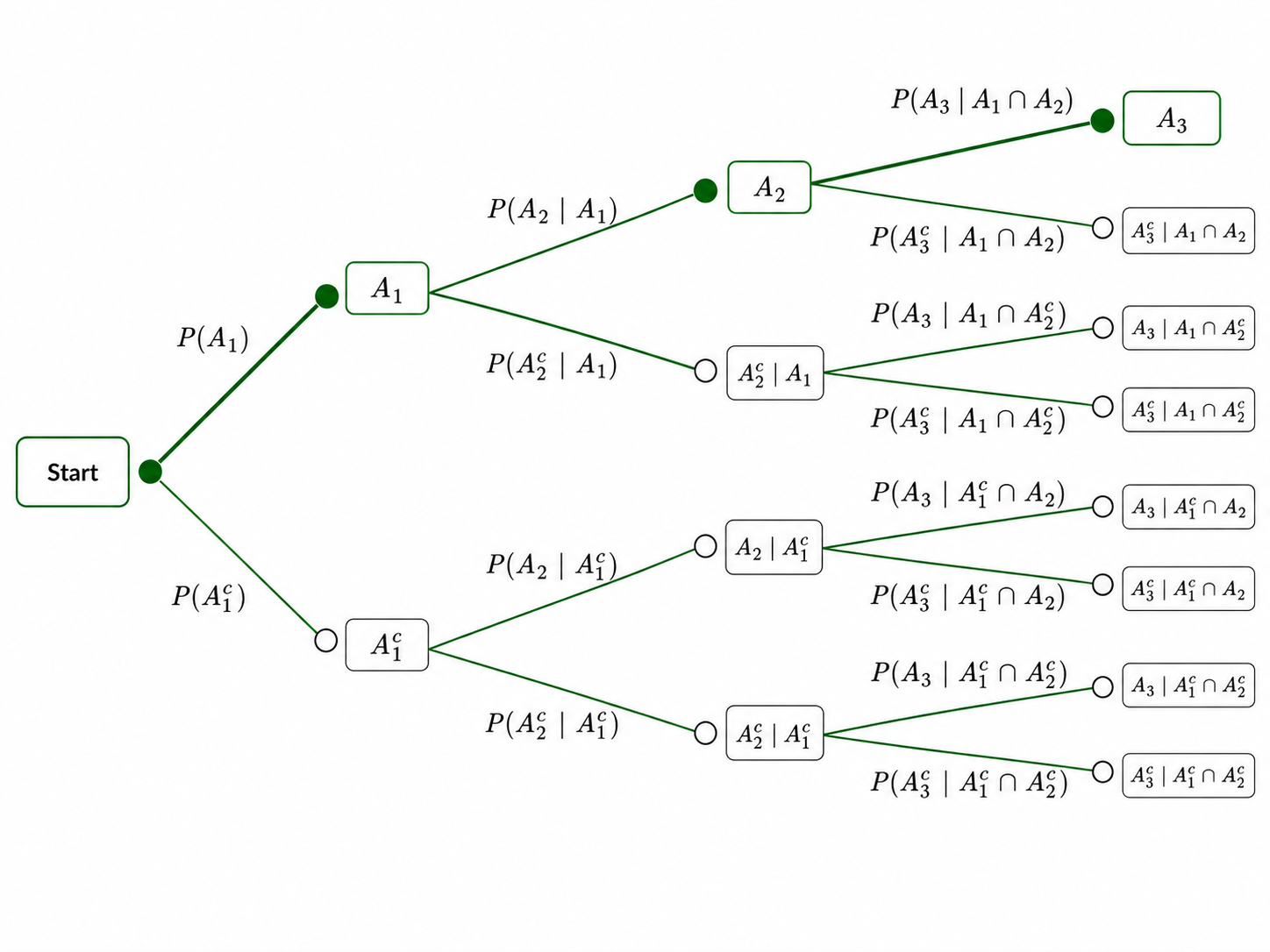
Sequential tree for drawing three cards without replacement.
The first branch uses \(4/52\) because there are 4 aces in a 52-card deck. After one ace has been drawn, the situation changes: there are now only 3 aces among 51 remaining cards. After two aces have been drawn, there are 2 aces among 50 remaining cards.
This example illustrates the key idea of dependent sequential events: the probability at each stage must be updated to reflect what has already occurred.
At every stage, update both
the number of cards remaining, and
the number of favorable cards remaining.
Because the draws are made without replacement, the events are not independent, so conditional probabilities are required.
1.6.16 Conditional Complement
The complement rule still works when a condition is given.
Suppose we know that \(A\) occurred.
Inside this condition, either \(B\) occurs or \(B^c\) occurs.
Therefore,
So,
Note
Complement Within the Same Condition
Keep the condition \(A\) unchanged.
The phrase within the same condition is important.
If the condition is \(A\), both probabilities must continue to use \(A\) as the condition.
1.6.17 Example 7: Draw One Red Card
One card is drawn from a standard 52-card deck.
Given that the card is red, find the probability that it is not a king.
Let
\(R\) = the card is red;
\(K\) = the card is a king.
There are 26 red cards.
Among the red cards, 2 are kings.
Therefore, 24 red cards are not kings.
Method 1: Count directly
Given red, the reduced sample space contains 26 cards.
There are 24 red cards that are not kings.
Thus,
Method 2: Use the conditional complement
Given red,
Therefore,
Both methods give the same result:
Notice that we do not use \(1-P(K)\).
The condition \(R\) must remain the same.
1.6.18 A Simple Method
For a conditional probability problem, use these steps.
Step 1: Translate the words.
Look for the word given.
For example,
probability of \(B\), given \(A\)
becomes
Step 2: Identify the condition.
The event after the bar is already known.
In
the condition is \(A\).
Step 3: Reduce the sample space.
Ignore outcomes outside the condition.
Ask:
Among the outcomes in \(A\), which ones also satisfy \(B\)?
Step 4: Choose the correct calculation.
For conditional probability,
For an intersection or sequential AND problem,
Step 5: Update sequential probabilities.
If the problem is without replacement, update the counts after each draw.
Step 6: For a tree diagram, follow the path.
Multiply the branch probabilities along one complete path.
Step 7: Keep the condition unchanged when using a complement.
1.6.19 Common Mistakes
A common mistake is to keep using the original sample space after a condition is known.
For the die example,
Given \(A\), the denominator is based on these 3 outcomes, not all 6 die outcomes.
Another mistake is to reverse the condition.
In general,
The event after the bar determines what is already known.
A third mistake is to confuse given with both.
Given A indicates a conditional probability:
Both A and B indicates an intersection:
Another mistake is to multiply \(P(A)\) and \(P(B)\) automatically.
The general multiplication rule is
not automatically \(P(A)P(B)\).
A fifth mistake is to forget to update the probability after sampling without replacement.
After one ace is drawn:
52 cards become 51;
4 aces become 3.
A final mistake is to change the condition when using a complement.
If
is required, use
not \(1-P(B)\).
1.6.20 Summary
Conditional probability describes the probability of an event when some information is already known.
The notation
means:
probability of \(B\), given \(A\).
The condition after the bar becomes the new reference space.
The conditional probability formula is
In general,
The multiplication rule is
or equivalently,
For three sequential events,
For sampling without replacement, update the number of possible and target outcomes after every stage.
For one path in a probability tree:
multiply the branch probabilities along the path.
The conditional complement rule is
The main relationships are:
GIVEN -> reduce the sample space
condition after the bar -> new denominator
AND -> intersection
intersection -> multiplication using conditional probability
sequential event -> update at each stage
tree path -> multiply branch probabilities
conditional complement -> keep the same condition