1.5 Probability Rules
Key Terms
- Overlap(重疊)
Outcomes that belong to both events.
- Exhaustive events(窮盡事件)
Events that together cover the whole sample space.
- At least one(至少一個)
One or more occurrences.
- Neither(兩者皆非)
Not in either of two events.
- De Morgan’s laws(德摩根定律)
Rules for rewriting complements of unions and intersections.
1.5.2 Learning Outcomes
After completing this section, students should be able to:
use the complement rule;
use a complement to solve an
at least oneproblem;use the addition rule for two events;
explain why an overlap must be subtracted;
recognize mutually exclusive events and use the simplified addition rule;
split one event into two non-overlapping parts;
use complements of combined events;
apply De Morgan’s laws;
add probabilities for several mutually exclusive events;
explain what it means for events to be exhaustive;
use the addition rule for three overlapping events;
translate words such as
not,or,at least one, andneitherinto event notation.
1.5.3 From Event Language to Probability Rules
In Section 1.2, we used complements, unions, and intersections to describe
events.
For example:
NOT \(A\) means \(A^c\);
\(A\) OR \(B\) means \(A\cup B\);
\(A\) AND \(B\) means \(A\cap B\).
In this section, we use the same event notation to calculate probabilities.
The main process is:
Words -> Event Notation -> Probability Rule
Before calculating, first decide what event the words describe.
The geometry of the event should be clear before a probability rule is applied. The following diagram illustrates several increasingly complex set operations.
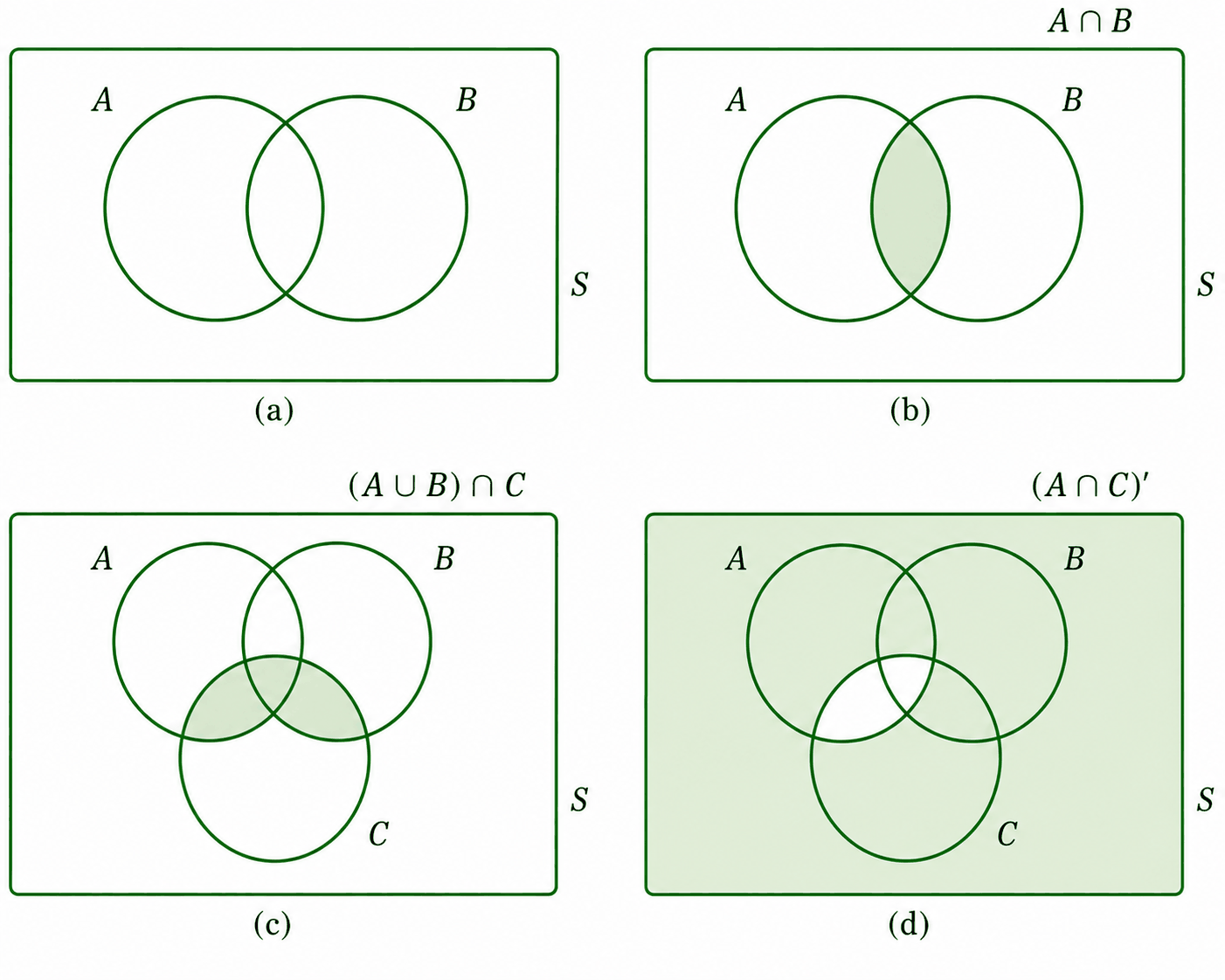
Read the four panels in terms of the region selected from the sample space:
Panel (a) shows the basic setting. Events \(A\) and \(B\) are subsets of the sample space \(S\) and may overlap.
Panel (b) isolates \(A\cap B\). Only outcomes satisfying both events are selected. This overlap is the region used by
A AND B.Panel (c) shows \((A\cup B)\cap C\). First form \(A\cup B\); then keep only the part that also belongs to \(C\). This illustrates why parentheses matter: a compound event can be built in stages.
Panel (d) shows \((A\cap C)^c\). First locate \(A\cap C\); then take its complement. The event therefore contains every point in \(S\) except the overlap of \(A\) and \(C\).
These shaded regions are the events whose probabilities we calculate. For example, \(P(A\cap B)\) assigns probability to the overlap in panel (b), while \(P((A\cap C)^c)\) assigns probability to the shaded complement in panel (d). The probability rules in this section provide efficient ways to calculate such regions without listing every sample point.
1.5.4 Complement Rule
An event \(A\) and its complement \(A^c\) cannot occur together.
Also, one of them must occur.
Therefore,
and
This gives the complement rule.
Note
Complement Rule
Equivalently,
The complement rule is useful when the opposite event is easier to
calculate.
Common words that may suggest a complement include:
not;none;at least one;neither.
1.5.5 Example 1: Roll One Fair Die
Question: One fair die is rolled. Let \(A\) be the event that the
number is greater than 4. Find the probability that \(A\) does not
occur.
The sample space is
The event is
Therefore,
The event that \(A\) does not occur is the complement \(A^c\).
Using the complement rule,
We can also check this directly.
The complement is
so
Both methods give the same result.
1.5.6 Example 2: At Least One Head
Question: A fair coin is tossed three times. Find the probability of
getting at least one head.
The phrase at least one head means one, two, or three heads.
We could list all outcomes that contain a head, but it is easier to use the
opposite event.
The opposite of at least one head is
no heads.
For three coin tosses, no heads occurs only when
There are
equally likely outcomes in total.
Therefore,
Using the complement rule,
Note
For an at least one problem, it is often easier to calculate
none first and subtract from 1.
This is a useful strategy, but it is still the same complement rule.
1.5.7 Addition Rule
Suppose we want the probability that event \(A\) or event
\(B\) occurs.
In probability, A or B normally includes three possibilities:
\(A\) occurs;
\(B\) occurs;
both \(A\) and \(B\) occur.
This is the union
If we simply add \(P(A)\) and \(P(B)\), any outcome in both events
is counted twice.
The outcomes in both events form the intersection
Therefore, we subtract the overlap once.
Note
Addition Rule
A simple way to remember the rule is:
add both probabilities -> subtract the overlap once
The shaded lens in panel (b) of the set-operations diagram is exactly this overlap. When \(P(A)\) and \(P(B)\) are added, that region is counted once through \(A\) and once again through \(B\). Subtracting \(P(A\cap B)\) once leaves each outcome in \(A\cup B\) counted exactly once.
1.5.8 Example 3: Roll One Fair Die
Question: One fair die is rolled. Let \(A\) be the event of rolling
an even number and \(B\) the event of rolling a number greater than 3.
Find the probability that \(A\) or \(B\) occurs.
The sample space is
The events are
and
Therefore,
and
The two events overlap at 4 and 6:
Thus,
If we calculate only
the outcomes 4 and 6 are counted twice.
Using the addition rule,
We can check the answer directly because
which contains 4 of the 6 equally likely outcomes.
1.5.9 Mutually Exclusive Events
Two events are mutually exclusive when they cannot occur together.
This means
Therefore,
The general addition rule then becomes simpler.
Note
Mutually Exclusive Events
If
then
The important point is to check whether the events can occur together
before using the simplified rule.
1.5.10 Example 4: Sum of Two Dice
Question: Two fair dice are rolled. Let \(A\) be the event that the
sum is 7 and \(B\) the event that the sum is 11. Find
\(P(A\cup B)\).
Each die has 6 possible outcomes, so there are
equally likely ordered outcomes.
A sum of 7 occurs for
Therefore,
A sum of 11 occurs for
Therefore,
One pair of dice cannot have a sum of both 7 and 11 at the same time.
Thus,
The events are mutually exclusive.
Therefore,
1.5.11 Splitting an Event into Two Parts
Sometimes an event can be separated into two smaller parts.
Suppose \(A\) is an event and \(B\) is another event.
Every outcome in \(A\) must either:
also belong to \(B\); or
not belong to \(B\).
Therefore,
The two parts cannot overlap because an outcome cannot be in both
\(B\) and \(B^c\).
Thus,
Because the two parts are mutually exclusive, their probabilities can be
added.
Note
Splitting an Event
Therefore,
This is useful when it is easier to understand or calculate the two parts
separately.
1.5.12 Example 5: Roll One Fair Die
Question: One fair die is rolled. Let \(A\) be the event that the
number is greater than 3, and let \(B\) be the event that the number is
even. Find \(P(A)\) by separating \(A\) according to whether
\(B\) occurs.
The event \(A\) is
The outcomes in \(A\) that are also in \(B\) are
The outcomes in \(A\) that are not in \(B\) are
These two parts do not overlap, and together they form \(A\).
Therefore,
Because the die is fair,
This agrees with the direct calculation because \(A\) contains three of
the six equally likely outcomes.
1.5.13 Complements of Combined Events
Sometimes the complement applies to a union or an intersection.
De Morgan’s laws tell us how to rewrite these events.
Note
De Morgan’s Laws
NOT (\(A\) OR \(B\)):
NOT (\(A\) AND \(B\)):
These formulas are easier to understand when translated into words.
Neither A nor B means that \(A\) does not occur and \(B\) does
not occur:
Not both A and B means that the intersection does not occur:
The words neither and not both are different.
Neithermeans neither event occurs.Not bothallows one event to occur, but not both together.
The first De Morgan law can be verified directly from the shaded regions.
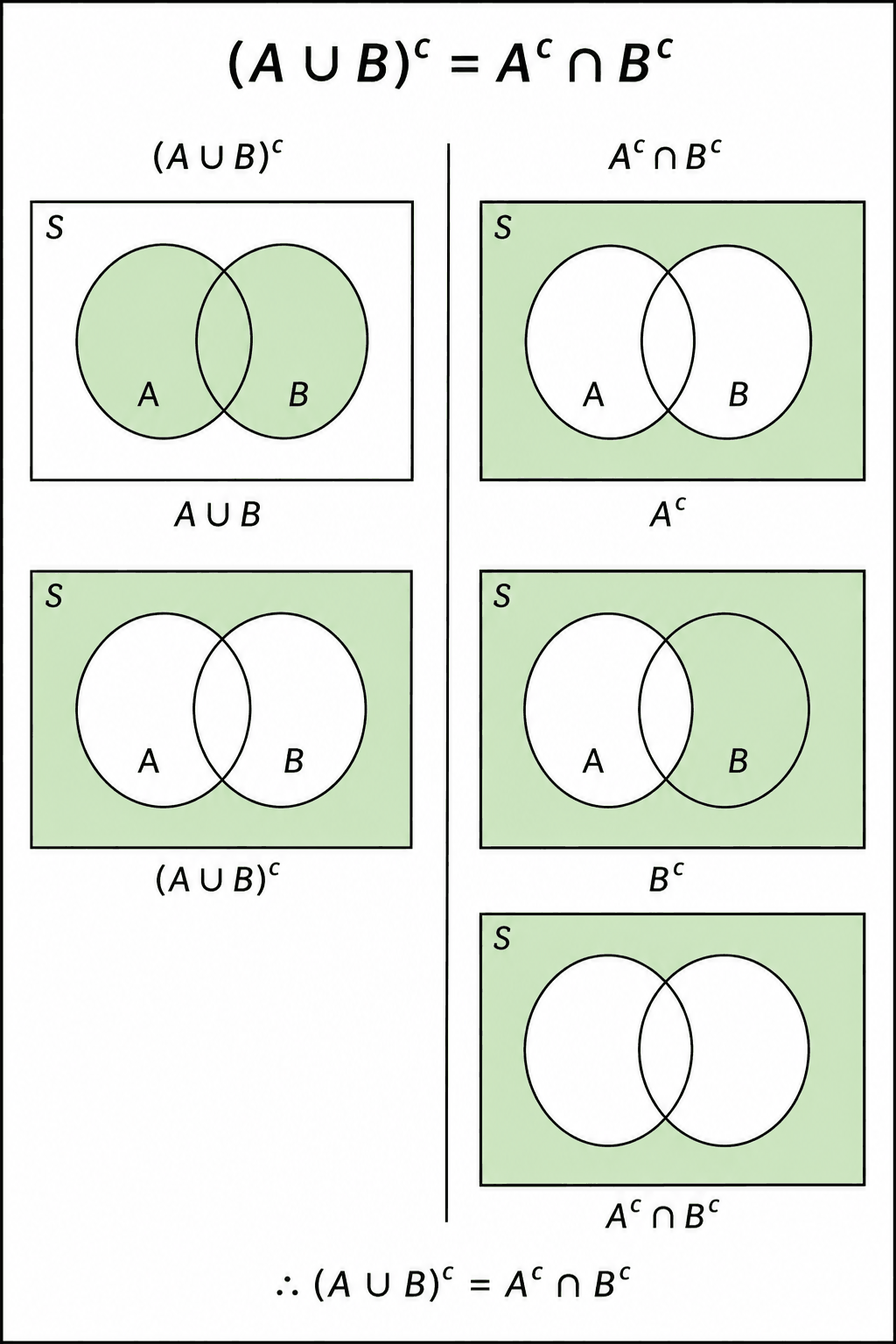
Start with the left side,
The union \(A\cup B\) contains every point inside either circle. Taking its complement removes both circles and leaves only the part of the sample space outside both events.
Now consider the right side,
The event \(A^c\) contains everything outside \(A\), and \(B^c\) contains everything outside \(B\). Their intersection keeps only outcomes satisfying both conditions: outside \(A\) and outside \(B\). This is exactly the same region obtained from \((A\cup B)^c\).
Therefore,
The diagram explains why OR changes to AND when the complement is
moved inside. To be outside the union, an outcome must be outside both
individual events.
The second De Morgan law follows the same logic:
Here, not both means an outcome fails at least one condition. It may be
outside \(A\), outside \(B\), or outside both, so the complements
are joined by a union.
Thus the ordinary-language translations are:
neither A nor B\(\rightarrow (A\cup B)^c=A^c\cap B^c\);not both A and B\(\rightarrow (A\cap B)^c=A^c\cup B^c\).
1.5.14 Example 6: Neither a Heart nor a King
Question: One card is drawn from a standard 52-card deck. Find the
probability that the card is neither a heart nor a king.
Let \(A\) be the event of drawing a heart.
Let \(B\) be the event of drawing a king.
There are 13 hearts and 4 kings.
However, the king of hearts belongs to both events.
Therefore,
The event neither a heart nor a king is the complement of
\(A\cup B\).
Using the complement rule,
By De Morgan’s law,
Therefore, the event can also be described as
not a heart AND not a king.
1.5.15 Several Mutually Exclusive Events
The addition idea also works for more than two mutually exclusive events.
Suppose
are mutually exclusive.
No two of these events can occur together.
Therefore,
There are no overlap terms to subtract because all intersections are empty.
1.5.16 Exhaustive Events
A group of events is exhaustive when the events together cover all
possible outcomes.
If
then the events are exhaustive.
If the events are both mutually exclusive and exhaustive, exactly one of
them must occur.
Because their union is the whole sample space,
For example, on one die roll, the six events
are mutually exclusive and exhaustive.
Only one can occur, and together they contain every possible die result.
1.5.17 Addition Rule for Three Events
For three events \(A\), \(B\), and \(C\), the events may
overlap in several places.
If we first add
the pairwise overlaps are counted more than once.
So we subtract
However, an outcome in all three events was originally added three times and
then subtracted three times.
It has now been counted zero times.
Therefore, we must add the triple intersection back once.
Note
Three-Event Addition Rule
A useful way to remember the pattern is:
add the three events
subtract the pairwise overlaps
add the triple overlap back once
Panel (c) of the set-operations diagram helps explain why three-event problems require more bookkeeping. Three events can create several pairwise overlap regions and, potentially, a central region belonging to all three. The three-event addition rule corrects the counting of these regions systematically.
If the three events are mutually exclusive, all intersection probabilities
are 0, so the formula reduces to adding the three probabilities.
1.5.18 Choosing a Probability Rule
Probability problems often become easier after translating the words into
event notation.
Use the following guide.
Words |
Event notation |
Main idea |
|---|---|---|
NOT \(A\) |
\(A^c\) |
Use \(1-P(A)\) |
\(A\) OR \(B\) |
\(A\cup B\) |
Add and subtract the overlap |
\(A\) or \(B\), but they cannot occur together |
\(A\cup B\) |
Mutually exclusive; add directly |
At least one |
Complement of none |
Often calculate none first |
Neither \(A\) nor \(B\) |
\((A\cup B)^c\) |
Find the union, then use the complement |
Not both \(A\) and \(B\) |
\((A\cap B)^c\) |
Complement of the intersection |
The general decision process is:
Words -> Event Notation -> Probability Rule
For example:
not A-> \(A^c\) -> complement rule;A or B-> \(A\cup B\) -> addition rule;A or Bwith no overlap -> mutually exclusive addition rule;at least one-> often use the complement of none;neither A nor B-> \((A\cup B)^c\);not both A and B-> \((A\cap B)^c\).
1.5.19 Common Mistakes
A common mistake is to add \(P(A)\) and \(P(B)\) without checking
for overlap.
For overlapping events,
Another mistake is to subtract the overlap when the events are mutually
exclusive.
If
then
so the probabilities can be added directly.
A third mistake is to read at least one as exactly one.
For three coin tosses, at least one head includes outcomes with one, two,
or three heads.
A fourth mistake is to confuse neither with not both.
Neither A nor B means
Not both A and B means
These are not the same event.
Another mistake is to split an event into parts that overlap.
When using
the two parts are useful because they are non-overlapping.
For three events, a common mistake is to subtract the three pairwise
intersections but forget to add the triple intersection back once.
1.5.20 Summary
The complement rule is
The general addition rule for two events is
If \(A\) and \(B\) are mutually exclusive,
and
An event can be split into two non-overlapping parts:
so
De Morgan’s laws are
and
For several mutually exclusive events,
If those events are also exhaustive,
For three overlapping events,
The main strategy is:
Words -> Event Notation -> Probability Rule
Before calculating, identify whether the problem involves a complement,
a union, an overlap, mutually exclusive events, or a combined-event
complement.