← Back to the internship homepage
Internship Logbook
Research progress, technical exploration, and experiences during my internship at CSDI Lab, National Taipei University of Technology.
Research and Project Progress 🤖
August 2026 — Research Environment and Initial Exploration
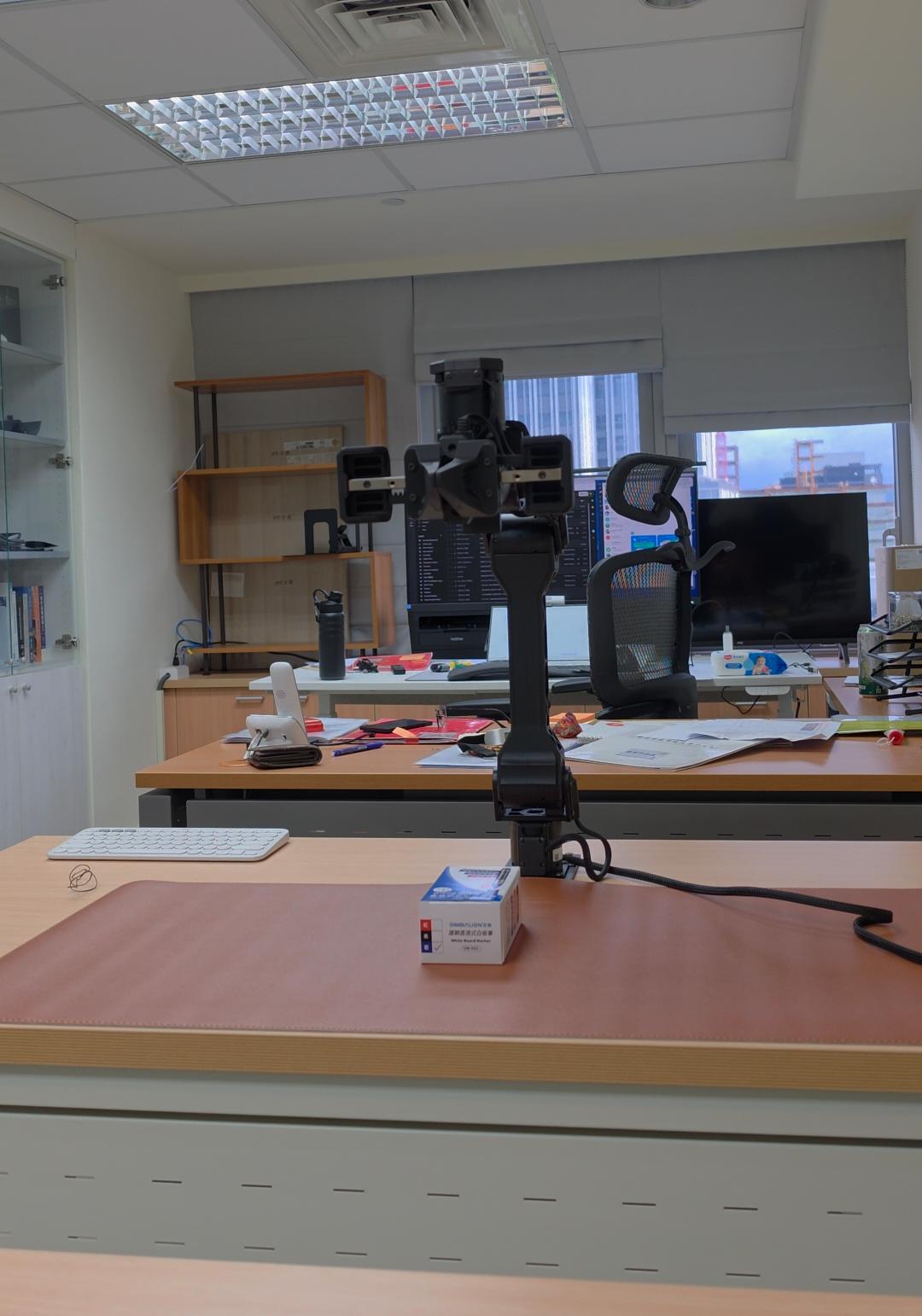
- Adapted to the laboratory environment and became familiar with the available robotics facilities.
- Explored the WidowX AI robotic arm and its potential applications in Human–Robot Interaction (HRI).
- Set up the initial software development environment for robotics and computer vision experiments.
- Began exploring possible research directions involving human intention recognition, visual perception, and robotic manipulation.
Laboratory environment
September 2026 — Learning and System Development
- Studied the fundamentals of Human–Robot Interaction and camera-based perception for robotic applications.
- Explored computer vision techniques using OpenCV and hand-tracking concepts using MediaPipe.
- Learned the fundamentals of ROS 2 and how it supports communication between robotic software components.
- Prepared the development environment for camera-based experiments and robotic simulation.
- Reviewed relevant research papers on human intention recognition, multimodal HRI, and vision-based interaction.
- Investigated how visual information and human gestures could be translated into commands for a robotic manipulator.
October 2026 — Computer Vision, Workspace Calibration, and Object Localization
- Developed an initial camera-based object detection and localization workflow using OpenCV and image-processing techniques.
- Implemented homography-based coordinate mapping to estimate an object’s position within a planar workspace.
- Conducted preliminary tests at different workspace positions to examine the consistency of estimated coordinates.
- Investigated potential sources of error when estimating the grasping point of a three-dimensional object from a camera image.
- Continued examining the relationship between camera-based position estimation and the robot’s coordinate system.
- Explored the use of MediaPipe hand landmarks as a foundation for gesture-based interaction.
- Reviewed the requirements for integrating camera perception with physical WidowX AI control.
The current calibration workflow uses a top-down camera and a mapped workspace of approximately 600 × 400 mm. The camera-to-workspace mapping is an intermediate step; it does not, by itself, establish a fully validated transformation from image coordinates to the robot’s base coordinate frame.
Object-tracking and workspace mapping
November 2026 — Breakfast Temporal Action Segmentation
- Reviewed 433 Breakfast Actions Dataset videos and labels for
cam01. Excluded two sequences because their supplied Fisher feature sequences ended substantially earlier than the labeled activity. - Prepared 431 sequences, covering approximately 932,664 timesteps and 50 classes, including
SIL. - Used the dataset’s supplied 64-dimensional Fisher features. The current pipeline uses these precomputed features and does not extract features directly from raw RGB video.
- Implemented MS-TCN++ model training in the local folder
/home/stevenchan/robotics/widowX_ai/breakfast training/. - Evaluated with four participant-group folds, holding out one of
s1–s4for testing in each fold. Ran four independent trainings of up to 100 epochs and selected each fold’s best checkpoint by validation frame accuracy. - The average held-out test results across the four folds were 44.55% frame accuracy, 45.79 edit score, 48.97% F1@10, 42.60% F1@25, and 31.04% F1@50.
The current result is offline temporal action segmentation: it labels actions across a completed feature sequence. It does not perform action anticipation, take new RGB video as input, provide real-time streaming predictions, or integrate with ROS 2 or the WidowX AI. The reports runs/cross_validation_summary.md and runs/cross_validation_summary.json are local outputs in the training folder and are not repository files.
November 2026 — 50Salads MS-TCN++ Cross-Validation
- Trained MS-TCN++ for 100 epochs in each of five official 50Salads folds. Each official fold contains 40 training and 10 held-out test sequences; two participants from the training partition were reserved for validation.
- The benchmark bundle contains 50 sequences, precomputed 2,048-dimensional RGB features, frame-level labels, and 19 action classes. It does not include the original videos, and the training pipeline does not extract features from raw RGB.
- Selected the best checkpoint per fold by validation frame accuracy. Fit feature normalization on the training partition only.
- Mean held-out results across the five folds: 75.50% frame accuracy (population standard deviation 4.55), 57.72 edit score (4.65), 66.85% F1@10 (4.28), 64.28% F1@25 (4.45), and 57.06% F1@50 (5.06).
- Reviewed fold 4 ground-truth-versus-prediction timelines for
rgb-18-2(47.2% per-sequence frame accuracy) andrgb-22-2(96.9%). These are individual examples and are not substitutes for the five-fold average. The chart x-axis is feature timestep, not seconds. - This is offline TAS on precomputed features. It does not perform action anticipation, take live RGB input, or provide real-time streaming inference.
The training code and full reports (runs/cross_validation_summary.md and runs/cross_validation_summary.json) are local outputs under /home/stevenchan/robotics/widowX_ai/50Salads training/. The two illustrative prediction timelines are available in the project highlights under docs/assets/figures/.
16 November 2026 — Object Anticipation Research Planning
This week’s work focused on clarifying the next research stage; it did not include a new implementation, training run, or evaluation.
- Defined the intended problem as anticipating an upcoming object or tool from manufacturing activity, so the WidowX AI could prepare it for a person. The dataset was described as fixed-camera videos with visible objects and annotations. Its files, annotation coverage, and suitability have not yet been independently inspected.
- Reviewed how MS-TCN/MS-TCN++ temporal convolutions and receptive field provide context for per-timestep action segmentation. A large receptive field alone does not make the standard non-causal model a future-action predictor; causal modeling or an explicit observation buffer would need to be considered for online use. Presentation material was requested, but no new presentation file or model implementation is recorded here.
- Set a staged environment plan: begin development and training on Windows, then move the model and its required preprocessing to Ubuntu for later WidowX integration. The discussed PC configuration is Intel Core Ultra 5 250K Plus, RTX 5060 with 8 GB VRAM, and one SSD for a Windows/Ubuntu dual boot. This is a plan, not a completed installation or compatibility test.
Status: the object-anticipation dataset pipeline, annotations, anticipation model, online inference, PC setup, and robot integration remain to be implemented and validated. No new metrics or training results are claimed for this planning update.
Research Direction — Temporal Action Understanding
The research direction is being refined from basic visual perception toward understanding human activities over time. The longer-term objective is to investigate whether a robotic arm can anticipate a person’s next action and prepare an appropriate response before the action is completed.
Two related but distinct tasks are being investigated:
1. Temporal Action Segmentation (TAS)
Temporal action segmentation assigns an action label to each frame or temporal segment in a video. For example, a recorded assembly sequence may be divided into actions such as picking up a component, positioning it, inserting it, and tightening it.
TAS can help the system understand which action is currently taking place and how the complete activity sequence is structured.
2. Action Anticipation
Action anticipation predicts an upcoming action before it begins or before the current action is completed. This differs from recognizing an action after it has already occurred.
For the WidowX AI application, anticipation could provide additional time for the robot to prepare for a subsequent manipulation task. The usefulness of a prediction depends on its accuracy, prediction horizon, computational latency, and the time required for the robot to execute the corresponding movement.
Literature Review and Models Under Investigation
Assembly101 and TempAgg
Assembly101 is a multi-view procedural activity dataset containing 4,321 videos of assembly and disassembly tasks, with fixed cameras and egocentric views. It supports action recognition, action anticipation, temporal action segmentation, and mistake recognition.
The original Assembly101 benchmark uses:
- TSM with a ResNet-50 backbone for visual feature extraction and action recognition.
- TempAgg for action anticipation.
- MS-TCN++ and C2F-TCN as temporal action segmentation baselines.
In the original benchmark, TempAgg anticipates upcoming fine-grained actions one second into the future. Its implementation and pretrained models are available in the official repositories.
- Assembly101 paper — CVPR 2022
- Assembly101 action anticipation code and models
- Assembly101 temporal action segmentation code and models
Investigating Longer Prediction Horizons
A recent paper, Look Here Next: Proactive Step Prediction and Visual Cueing for Hands-Free Augmented Reality Maintenance Walkthroughs, reports TempAgg results at anticipation horizons of one, two, and three seconds on the MaintAR-52 dataset. Its reported Top-1 and Top-3 accuracy are:
| Prediction horizon | Top-1 accuracy | Top-3 accuracy |
|---|---|---|
| 1 second | 69.2% | 82.5% |
| 2 seconds | 63.8% | 78.1% |
| 3 seconds | 55.0% | 70.3% |
These results provide evidence that longer-horizon action anticipation can be evaluated experimentally. They are results from MaintAR-52, not results from the current WidowX AI project. Performance on the intended assembly dataset may differ.
Reference: Look Here Next — research paper
Temporal Action Segmentation and STASDiff
STASDiff is another approach under investigation for temporal action segmentation. It combines visual features, text-related information, and diffusion-based feature enhancement with an ASFormer-based segmentation model.
The approach is relevant to assigning frame-level action labels to procedural videos. However, temporal segmentation and future action anticipation remain different objectives. A segmentation model’s performance should not be interpreted as evidence that it can predict future actions.
Potential comparisons include:
- C2F-TCN: a candidate baseline for temporal action segmentation.
- MS-TCN++: another established segmentation baseline.
- STASDiff: an advanced approach to investigate for segmentation.
- TempAgg: a candidate baseline for action anticipation.
The model choice will depend on the available annotations, computational requirements, reproducibility, and the final research objective.
Computer Vision Components — Current Understanding
The investigation has also clarified the different roles of the visual-processing components:
- OpenCV: camera input, image processing, visualization, and geometric coordinate mapping.
- MediaPipe: hand-landmark estimation for gesture recognition.
- YOLO: a candidate for object detection when both object classes and image locations are needed.
- ResNet-50: a visual feature-extraction backbone used in the Assembly101 TSM pipeline.
- TSM / TempAgg: temporal video understanding and action anticipation components, depending on the model and task.
- ROS 2: the communication layer for integrating perception, decision-making, and robot-control components.
These components are complementary rather than interchangeable. The final system architecture will depend on whether the task requires object localization, gesture recognition, action segmentation, action anticipation, or a combination of them.
Current Research Direction and Proposed Pipeline
The working research direction is to investigate video-based human action understanding and anticipation for proactive robotic assistance. The proposed pipeline is:
- Video acquisition: obtain assembly or manipulation videos, potentially using the multi-camera recordings available from a collaborator.
- Visual feature extraction: extract frame-level features using a suitable pretrained video or image backbone.
- Temporal action segmentation: identify the sequence and boundaries of actions in the recorded activity.
- Action anticipation: predict the next action at a defined future horizon.
- Decision layer: determine whether the prediction provides sufficient confidence and lead time for a useful robotic response.
- Robot integration: translate validated predictions into safe commands for the WidowX AI through the appropriate control interface and ROS 2 integration where applicable.
- Evaluation: compare model performance and measure whether anticipation provides useful preparation time for the robot.
The proposed prediction horizons are one, two, three, and potentially five seconds. These are planned experiments, not yet validated capabilities of the current physical robot system.
The availability, annotation format, camera synchronization, and permitted use of the collaborator’s dataset must be confirmed before selecting the final training and evaluation protocol.
Current Status
Work completed or explored
- Initial camera-based object localization and image-processing workflow.
- Homography-based mapping of a planar workspace.
- Preliminary investigation of MediaPipe for hand-landmark estimation.
- Initial exploration of ROS 2, robotic simulation, and physical WidowX AI control.
- Literature review covering action segmentation, action anticipation, Assembly101, TempAgg, and STASDiff.
Work in progress
- Validation of camera-to-workspace mapping and the transformation to robot coordinates.
- Refinement of the research question and experimental scope.
- Examination of suitable datasets, annotations, model implementations, and pretrained checkpoints.
- Planning an evaluation protocol for action anticipation at multiple prediction horizons.
Not yet established
- Reliable camera-to-robot coordinate transformation for the complete physical manipulation pipeline.
- Validated online action anticipation on the intended assembly dataset.
- Successful end-to-end integration of temporal predictions with safe physical robot movements.
- Experimental evidence that a five-second prediction horizon is sufficiently accurate or useful.
Next Steps
- Validate workspace calibration and coordinate transformations before executing physical movements.
- Confirm access to the multi-camera assembly dataset and inspect its labels, timestamps, and synchronization.
- Establish a reproducible temporal action segmentation baseline, initially considering C2F-TCN or MS-TCN++.
- Evaluate TempAgg or another suitable anticipation model using a clearly defined prediction horizon.
- Compare anticipation performance at one, two, three, and, if feasible, five seconds.
- Establish evaluation metrics, including action-prediction accuracy, temporal segmentation metrics, inference latency, and available preparation time.
- Design a safe decision layer between model predictions and physical WidowX AI commands.
- Conduct controlled tests before evaluating the complete perception-to-action pipeline.
Cultural Experiences and Exploration 🌏
During the internship, I also used my free time to explore Taiwan, experience local food, visit historical sites, and appreciate the island’s natural scenery.
Historical and Cultural Sites
-
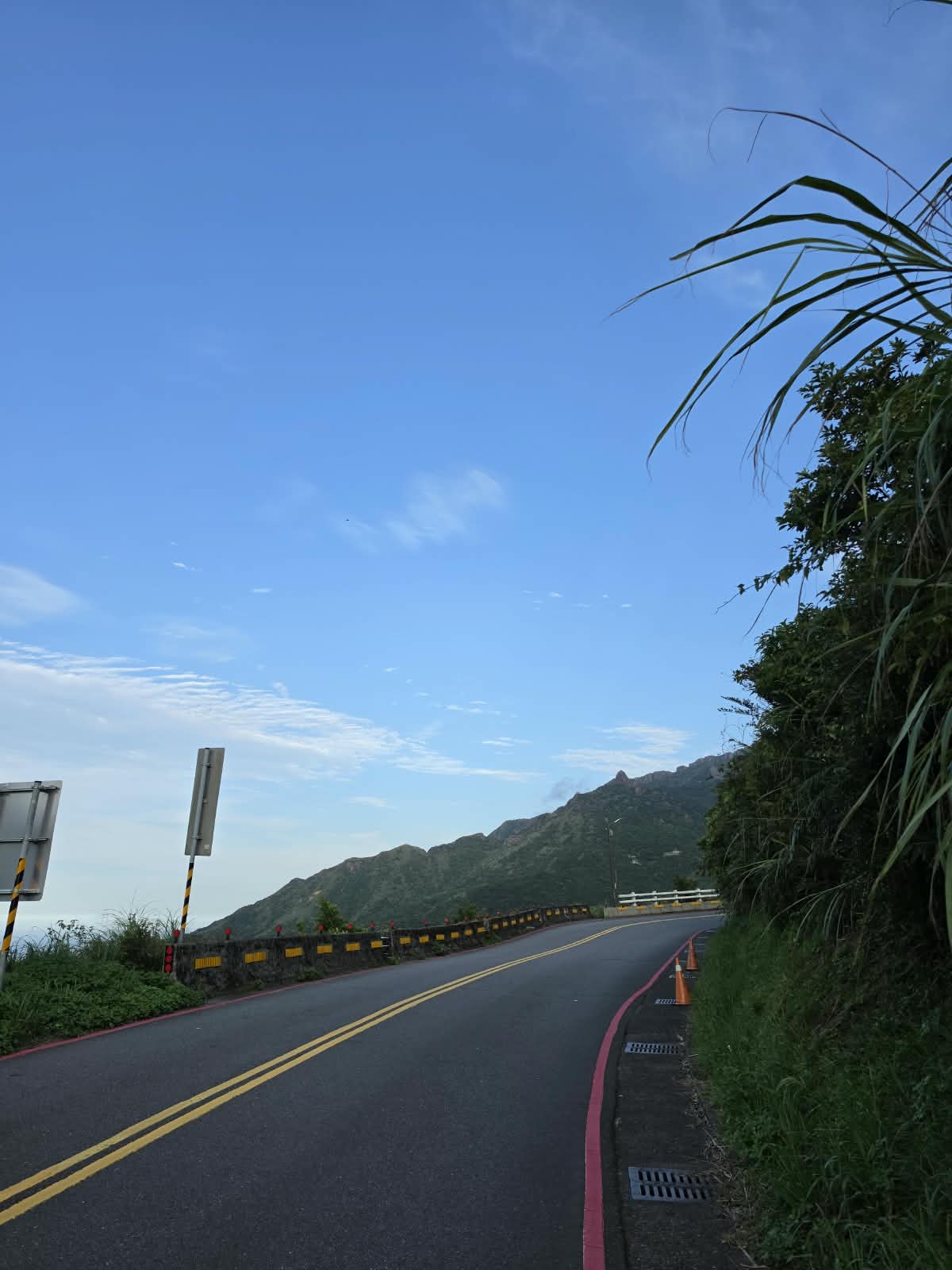
Jiufen Old Street and surrounding trails — Explored traditional streets, local food, and mountain scenery.


-
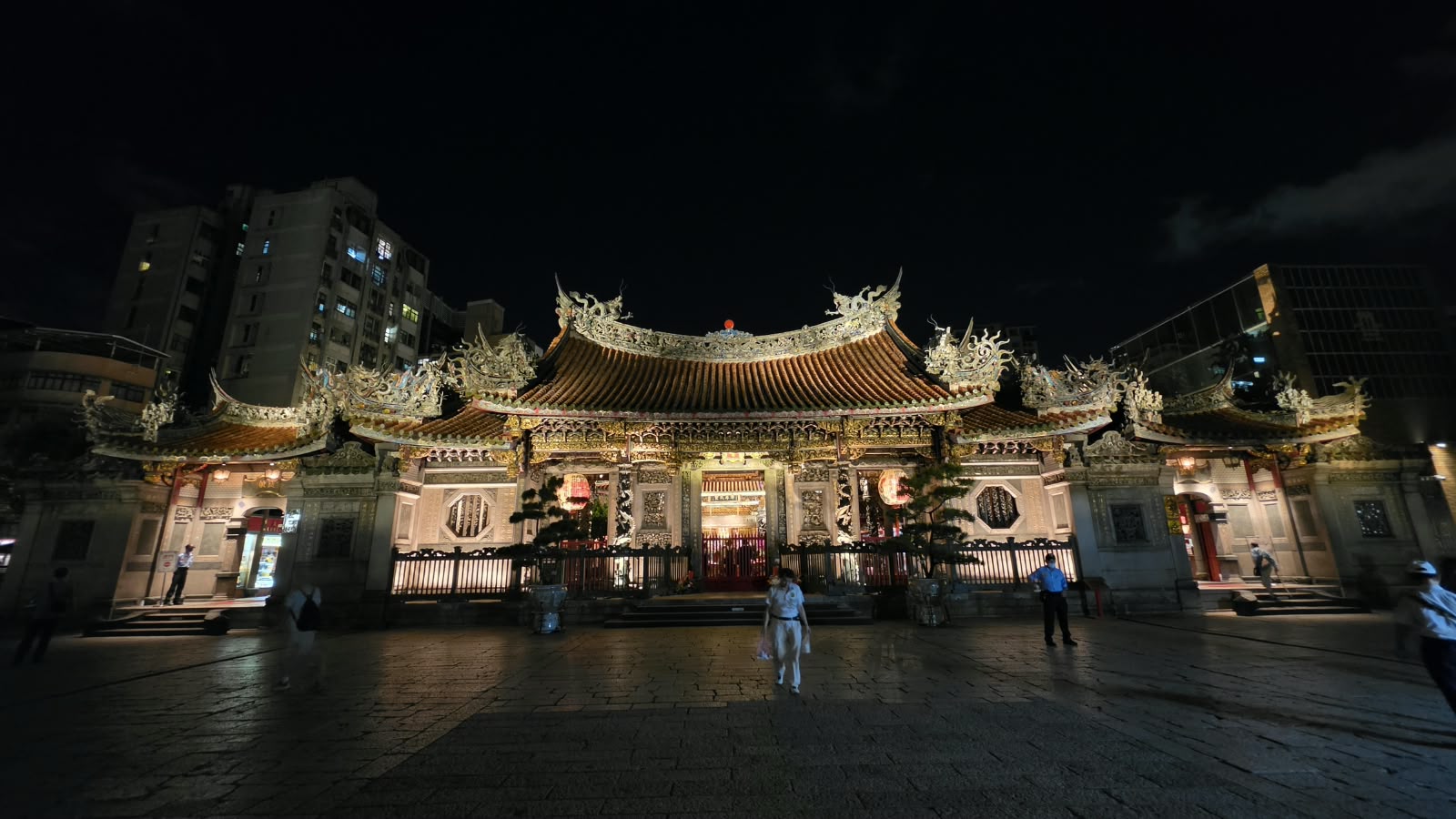
Longshan Temple — Observed traditional Taiwanese temple architecture and local religious culture.

Nature and Scenic Destinations
- Elephant Mountain Trail — Hiked to enjoy views of Taipei and its skyline.
- Nanzilin Trail — Explored a coastal hiking route with views of the surrounding hills and sea.
- Tamsui Fisherman’s Wharf — Enjoyed the waterfront scenery and sunset around the harbor.
Local Lifestyle and Food
- Ximending — Explored a popular shopping and entertainment district.
- Shilin Night Market — Experienced Taiwanese street food and the atmosphere of a local night market.
These activities provided opportunities to experience Taiwan beyond the laboratory and develop a better understanding of its local culture and daily life.
Personal Development
Throughout the internship, I have continued to:
- Develop practical skills in robotics, computer vision, and software-based experimentation.
- Become more familiar with the research and development process in a laboratory environment.
- Improve my understanding of the distinction between perception, temporal action understanding, and robotic control.
- Develop a more structured approach to evaluating research papers, identifying baselines, and defining experiments.
- Improve my independence and adaptability while living in a new country.
- Learn more about Taiwanese culture and daily life through local exploration.
References and Technical Resources
- Sener et al., “Assembly101: A Large-Scale Multi-View Video Dataset for Understanding Procedural Activities,” CVPR 2022. Paper
- Assembly101 action anticipation implementation. GitHub repository
- Assembly101 temporal action segmentation implementation. GitHub repository
- “Look Here Next: Proactive Step Prediction and Visual Cueing for Hands-Free Augmented Reality Maintenance Walkthroughs.” ResearchGate
- STASDiff — paper reviewed during the research discussion. Bibliographic details and the final citation should be added from the original paper before formal submission.
- Wang et al., “Multimodal Human–Robot Interaction for Human-Centric Smart Manufacturing.” Relevant to the broader HRI literature review; complete bibliographic details should be verified before formal submission.
- Berg and Li, “Review of Interfaces for Industrial Human-Robot Interaction.” Relevant to the broader HRI literature review; complete bibliographic details should be verified before formal submission.
This logbook is a living document and will be updated periodically to record research progress, technical development, experimental results, and experiences throughout the internship. Planned work and literature-reported results are distinguished from experiments completed in the current project.