Research on Temporal Action Segmentation
A little more about what was happening at CSDI Lab.
Refined the project toward temporal action segmentation for future human–robot interaction and evaluated MS-TCN++ baselines on Breakfast and 50Salads. The five-fold 50Salads evaluation averaged 75.50% frame accuracy; the four-fold Breakfast evaluation averaged 44.55%.
Continued research work and project documentation after the internship period.
Temporal action segmentation labels actions across an observed sequence; it is distinct from anticipating a future action. Both current evaluations use precomputed features and are offline.
Research direction
The project scope was refined toward temporal action segmentation (TAS) as a practical step toward future human–robot interaction with WidowX AI. TAS assigns action labels over time; action anticipation is a separate task that predicts what will happen next. The segmentation results below do not demonstrate action anticipation or robot integration.
The Breakfast Actions Dataset and 50Salads were used to establish and compare segmentation baselines. The collaborator’s eight-camera assembly recordings remain a possible future data source, subject to confirming access, annotations, and suitability.
Breakfast TAS experiment
Reviewed 433 Breakfast Actions Dataset videos and labels for cam01. Excluded two sequences because their supplied Fisher feature sequences ended substantially earlier than the labeled activity. Prepared 431 sequences, covering approximately 932,664 timesteps and 50 classes, including SIL.
The training pipeline uses the dataset’s supplied 64-dimensional Fisher features rather than extracting features from raw RGB video. Four participant-group folds held out one of s1–s4 for testing. Four independent MS-TCN++ trainings ran for up to 100 epochs, with the best checkpoint in each fold selected by validation frame accuracy.
Average held-out test metrics across the four folds:
| Metric | Average |
|---|---|
| Frame accuracy | 44.55% |
| Edit score | 45.79 |
| F1@10 | 48.97% |
| F1@25 | 42.60% |
| F1@50 | 31.04% |
This is offline temporal action segmentation over a completed feature sequence. It does not accept new RGB video directly, provide real-time streaming predictions, or integrate with ROS 2 or the WidowX AI. Training code and local reports are under /home/stevenchan/robotics/widowX_ai/breakfast training/; the reports runs/cross_validation_summary.md and runs/cross_validation_summary.json are local outputs and are not committed here.
50Salads five-fold evaluation
Completed five official-fold MS-TCN++ trainings on the 50Salads dataset, with 100 epochs per fold. Each fold used 40 sequences for training and 10 held-out sequences for testing; two participants from the training split were held out for validation. The best checkpoint was selected by validation frame accuracy. Feature normalization was fit on training data only.
The prepared benchmark contains 50 sequences of precomputed 2,048-dimensional RGB features, frame-aligned action labels, and 19 action classes. The available bundle does not include the original videos, and this pipeline does not extract features directly from RGB video.
Average held-out test metrics across the five official folds:
| Metric | Mean | Population standard deviation |
|---|---|---|
| Frame accuracy | 75.50% | 4.55 |
| Edit score | 57.72 | 4.65 |
| F1@10 | 66.85% | 4.28 |
| F1@25 | 64.28% | 4.45 |
| F1@50 | 57.06% | 5.06 |
The charts compare ground-truth and predicted action segments for two fold 4 test sequences. Their displayed frame accuracies (47.2% for rgb-18-2 and 96.9% for rgb-22-2) illustrate variation between examples; the cross-fold mean above is the aggregate result. The horizontal axis is feature timestep, not seconds.
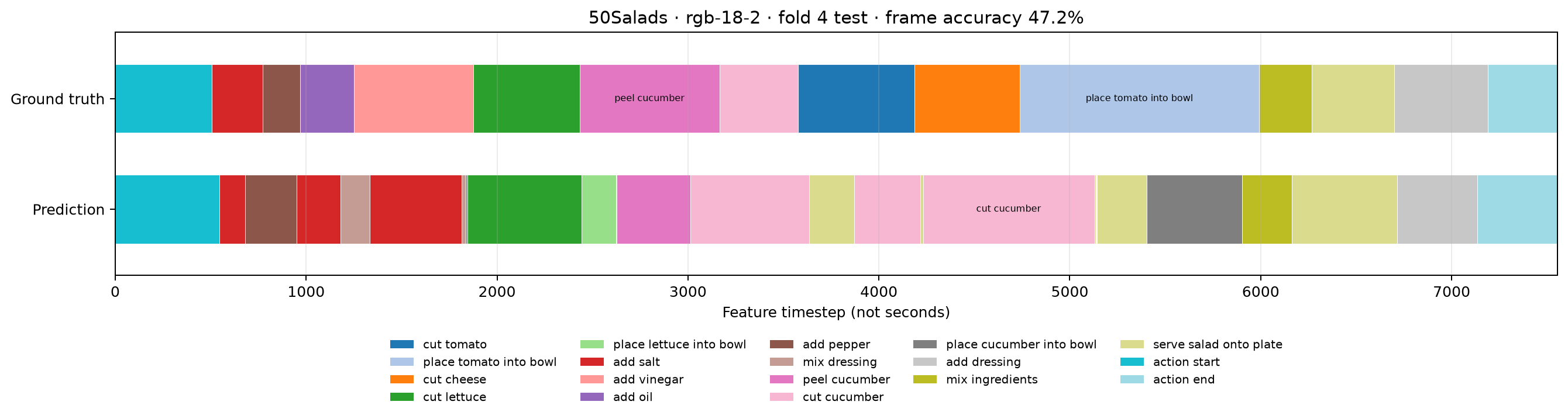
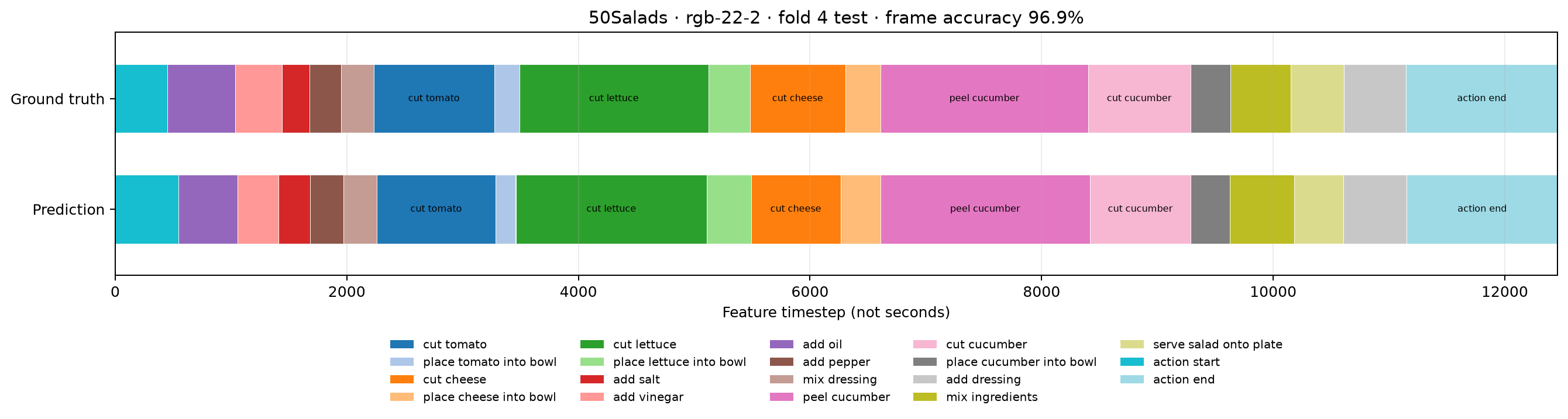
This is also offline segmentation over precomputed features. It does not anticipate future actions, accept live RGB input, or provide real-time streaming inference. The 50Salads code and full cross-validation reports remain local in /home/stevenchan/robotics/widowX_ai/50Salads training/; only these two prediction visualizations are included with this progress update.
Next steps
Continue by validating the research dataset and annotation format, making the preprocessing reproducible, and then evaluating a separately defined action-anticipation task. Real-time inference and WidowX AI integration remain later stages.